Monday, October 10, 2011

Music #106 -Mozart Symphony No.40

Symphony No.40 

- aka the 'Great G minor symphony', K.550
"a work of passion, violence and grief"
👍👍👍👍👍

Mozart composed his 3 final and greatest symphonies (Nos.39-41) in rapid succession in the summer of 1788.
Mvt.1 Molto allegro
Mvt.2 Andante
Mvt.3 Menuetto allegretto - Trio
Mvt.4 Allegro assai

= = = = =
Encore:

Mvt.1
piano duet


Music #105 -Mozart Symphony No.39

Symphony No.39 

- K.543

No.39 is happy and bright.
 
Mvt.1 Adagio - Allegro 
Mvt.2 Andante 
Mvt.3 Menuetto 
Mvt.4 Allegro 

Mozart composed his three final and greatest symphonies (Nos. 39-41) in rapid succession in the summer of 1788.


Music #104 -Mozart Symphony No.38

Symphony No.38 

- aka the 'Praque' Symphony, K.504

Prague
"It was premiered in Prague, a few weeks after Le nozze di Figaro opened there."  In Prague, the Marriage of Figaro was a tremendous success, after the same in Vienna.

Mvt.1 Adagio & Allegro
Mvt.2 Andante
Mvt.3 Presto


Friday, October 7, 2011

Music #103 -Mozart Symphony No.36

Symphony No.36 

- aka the 'Linz' Symphony, K.425
 
Mvt.1 Adagio & Allegro spiritoso 
Mvt.2 Poco adagio 
Mvt.3 Menuetto 
Mvt.4 Presto 
 
'Every movement except the minuet is in sonata form.'  


'It was written by Mozart during a stopover in the Austrian town of Linz ... in late 1783.' 
 
(Later, Hitler attended school in this town.)


Thursday, October 6, 2011

Music #102 -Mozart Symphony No.35

Symphony No.35 

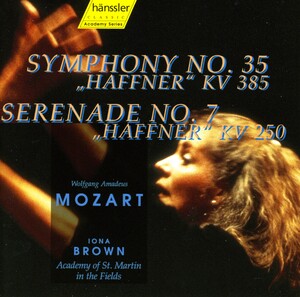
- aka the 'Haffner' SymphonyK.385

Mvt.1 Allegro con spirito
Mvt.2 Andante
Mvt.3 Menuette
Mvt.4 Presto

Haffner was a prominent family in Salzburg, where Mozart was born.

In 1776, Mozart was commissioned to write a serenade for the wedding of a Haffner daughter. It was Mozart's Serenade No.7 (K250) with 8 movements, popularly known as the 'Haffner Serenade'.

In 1782, Mozart was commissioned again, via his father, to write another serenade (as background music) for the ennoblement of a Haffner son, the Salzburg mayor.

Mozart was busy elsewhere, and Mozart's marriage with Constanze Weber was not quite accepted by his father --- movements by movements the scores were mailed to the father, but seemed not all in time for the ceremony.

In the following spring, Mozart got the scores of the Haffner Serenade No.2 mailed back from his father, and converted into this Haffner Symphony.


Tuesday, October 4, 2011

Music #101 -Mozart Symphony Nos. 23, 25

Symphony No.25 

- aka the 'Little G minor symphony', K.183/173dB

No. 25 is full of sadness and bitterness, other than some occasional sweet and peaceful atmosphere in mvt. 3 menuetto.

with an opening Mannheim rocket, an arpeggiated sequence
Mvt.2  Andante
Myt.3  Menuetto & Trio
Mvt.4  Allegro

 score

Movement 1 is widely known as the 
opening music in Amadeus (1984 film)
(after 20 seconds from Prelude of Mozart's Don Giovanni)


Joyful by nature, Mozart has only 2 symphonies in G minor.  The other one is No.40, aka the  'Great G minor symphony'.


Symphony No. 23 

- aka "Overture", K.181/162b
- scoring of 2 oboes, 2 horns, 2 trumpets, and strings
- Mozart wrote the symphony as a single uninterrupted movement consisting of 3 distinct tempi: Allegro spiritoso, Andantino grazioso, Presto assai.


Sunday, October 2, 2011

Music #100 -MOZART

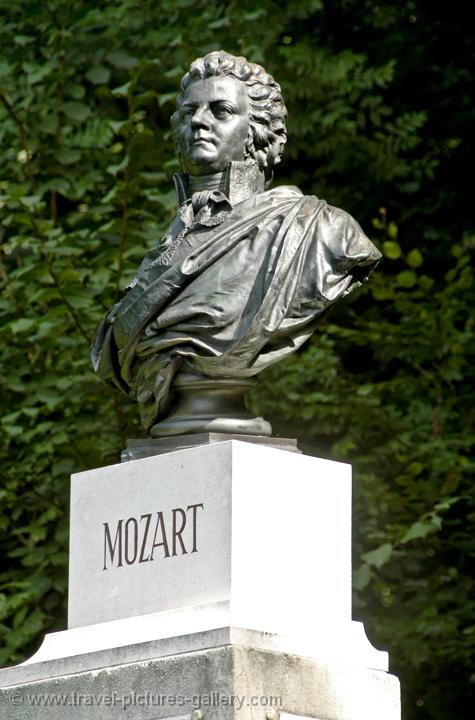
Wolfgang Amadeus Mozart 

[ˈvɔlfɡaŋ amaˈdeus ˈmoːtsaʁt] (1756 – 1791)


The range of Mozart's musical output is extraordinary, and equally accomplished in so many different media. 
But his greatest love was opera (see Set #181-185 in this blog). 
Mozart was the most brilliant pianist of his age. He took the piano concerto (see Set #121-129) to new heights of richness and virtuosity.

Mozart was the first important composer to attempt to establish a freelance musical career.
“莫扎特一生最大的貢獻就是教會了樂器如何‘歌唱’。雖然他一生坎坷,但他的音樂總是展現歡樂、慈愛、甜美、寧靜,給人的心靈帶來和諧安寧的撫慰。”

= = = = = 

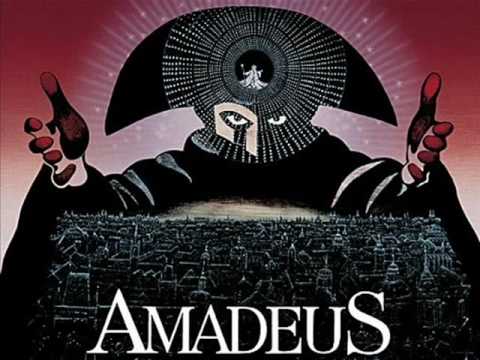
The Amadeus (1984 movie) 

is a lively presentation of Mozart's life story.
Here's a briefing, in Chinese, of the movie.
 

List of music pieces played in The Amadeus (1984 movie):

“March of Welcome” (for Mozart) composed by Salieri 
 - Excerpt from the “Amadeus” (1984 movie)
 
Joseph II, Holy Roman Emperor granted an audience and an engagement to Mozart. Unworldly Mozart unknowingly offended Salieri in their very first meeting and for the rest of Mozart's short life.

 
(R) 為什麼莫札特的音樂聽起來很悅耳


= = = = =

Joseph II 

had quite a miserable ending:  
... In November 1788, [Joseph] returned to Vienna with ruined health, and during 1789, was a dying man. Joseph was left entirely alone. His minister Kaunitz refused to visit his sick-room and did not see him for two years. His brother Leopold remained at Florence. At last, Joseph, worn out and broken-hearted, ... died on 20 February 1790. 
        He is buried in tomb number 42 in the Imperial Crypt in Vienna. He asked that his epitaph read: "Here lies Joseph II, who failed in all he undertook." Joseph was succeeded by his younger brother Leopold II, who put his priorities on state matters.  Mozart then lost his income from the court and the nobles.
[Source: Wikipedia]

= = = = = 
Salzbourg = salt city, a city sitting on salt rocks. That's where Mozart was born and brought up.
        In his 35 years of life, Mozart had more than 600 compositions, which were dispersed all over the places.
        In 1862,Ludwig von Köchel completed assigning a Köchel catalogue number (e.g. K.361) chronologically to every one of Mozart's known works. It has since been repeatedly updated.
[Source: Wikipedia]

= = = = =
Little Mozart
with his father Leopold
and sister Nanneri
Wolfgang Amadeus Mozart's parents gave birth to 7 children, but only his elder sister Nannerl and he lived. Amadeus's father Leopold was a gifted musician, and Nannerl a child prodigy. Soon his own gifts surpassed hers. Leopold gave up his career to promote their talents before the astounded royalty and cognoscenti in Europe.

Mozart plays the harpsichord
for King George III, in London
Giacomo Mantegazza (Italian, 1853–1920)
- (40 x 27 cm) c.1891
- Getty collection

The Mozarts at the Schoenbrunn Palace, Vienna.
The six-year-old prodigy Wolfgang Amadeus Mozart gave a concert for Empress Maria Theresa in 1762. As recorded by his proud father Leopold Mozart, after the performance ‘Wolferl leapt onto Her Majesty’s lap, flung his arms around her neck and covered her with kisses’

The social status of a court musician was between the valets and the cooks. Never happy at the small court of Salzburg, he left to become one of the first freelance musicians. He arrived in Vienna in 1781.
     Mozart and his wife Constanze gave birth to 6 children, but only 2 lived to adulthood: Carl Thomas (1784-1858), a legal recorder, and Franz Xavier Wolfgang (1791-1844), a music worker. Neither of them got married.
  
Mozart had many various sickness since a little kid. When his father was dying, he was himself sick with flu, whose virus spread to various organs; at the same time, his wife's legs were also sick. He was thus not able to attend to his father's sickness, like his sister Nannerl; neither was he able to attend to his father's funeral. (This is different from the Amadeus movie.) Then, he and his sister fought over his dead father's assets.

Death of Mozart 

Researchers have posited at least 118 causes of his death... The most widely accepted hypothesis is that Mozart died of acute rheumatic fever. 
* Dr Jan V Hirschmann's hypothesized that Mozart died of a parasite in the not-well-cooked fried pork and ribs that he consumed; he wrote to his friends about his pork meals, and his symptoms matched with the 50+ day development cycle.
* After 30, Mozart had swollen faces and plain lifeless eyes, which were symptoms of chronic kidney disease.
   
It was said that his funeral was held on a rainy bad-weather day, that turned back the procession members. His lonely corpse was buried in a nameless graveyard (according to Viennese custom?), and could not be located the next day and thereafter. Poor man and poor soul.

= = = = =

BBC - The Genius of Mozart 

(1 hour per episode)


Peter Ustinov presents 2 hours of Mozart Mystique Documentary in 12 episodes.