Sunday, January 15, 2012

Music Set #205 - Bizet - Symphony in C

(1838-1875)
   
was completed by Bizet at age 17.
Part 1  Part 2  Part 3  Part 4 
Totaling about 37 minutes
     
Professor Rogoff gives an interesting briefing on Symphony in C

In 1947, George Balanchine adopted Symphony in C to ballet, as beautifully performed by the following companies:
Houston Ballet   (cute dolly ballerinas)
Miami City Ballet:   Part 1   Part 2   
   
See the ballerinas' chopstick legs in amazingly beautiful ballet movements?

Music Set #205 - Bizet - Carmen

(1838-1875)
  
Bizet is well-known for his opera (in French) Carmen, the name of this wild factory gypsy girl in Sèville (/səˈvɪl/), Spain.

to watch the complete opera  (4 acts, in 20 parts)
  
Or, just 4 well-known extracts:
Prelude  (Overture)
Habanera: L'amour est un oiseau rebelle  (Love is a rebellious bird)
Seguidilla: Près de remparts de Sèville  (Near the ramparts of Seville)
Toreador (bullfighter) song: Votre toast, je peux vous le rendre  (Your toast, I can make it)

Plus: Avec La Garde Montante  (Street Boys March)

Music Set #204 - Berlioz - March to the Scaffold

[ɛk'tɔʁ bɛʁ'ljoːz] [BARE-lee-O’s] (1803-1869)


The Fantastic Symphony has 5 movements:

1.      Rêveries - Passions (Daydreams - Passions) – day-dreaming for love
2.      Un bal (A ball) – meeting the dream girl
3.      Scène aux champs (Scene in the Country) – passion of love; pain of failure; killing the girl
4.      Marche au supplice (March to the Scaffold) – for the crime of killing 
5.      Songe d'une nuit de sabbat (Dream of a Witches' Sabbath)


Mvt.4 - March to the Scaffold

Music Set #203 - Berlioz - Rakoczy March

[ɛk'tɔʁ bɛʁ'ljoːz] [BARE-lee-O’s] (1803-1869)


Originally a slow and sad song by an unknown writer, it was then frequently rewritten to various tempos and versions, and named after Prince Rakoczy, a Hungarian national hero. 

Berlioz rewrote it as a Hungarian March (La Marche Hongroise) for concerto, and made it the 4th song in Part 1 of his operatic Damnation of Faust. 
       
Here, the aging scholar Faust (as Goethe’s Faust 歌德名著浮士德) hears an army marching past in the distance.   

Saturday, January 14, 2012

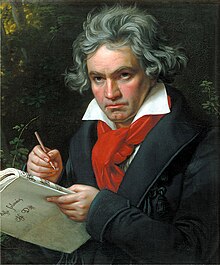
Music Set #202 - Beethoven

A biography (1 hour) 
Ludwig van Beethoven  
(1770 – 1827)

Wellington's Victory
over Joseph Bonaparte's forces 

at the Battle of Vitoria in Spain
It uses older themes, such as 
"Rule Britannia," and 
"Marlbrough s'en va-t-en guerre" / "Marlborough Has Left for the War" (Marlborough is the name of an English general [an ancestor of Winston Churchill] who fought against the French at the Battle of Malpaquet in 1709, during the reign of Louis XIV.)
– the tune now known as "The Bear Went Over the Mountain" or "For He's a Jolly Good Fellow."
  

Wednesday, January 11, 2012

Music Set #201 - Beethoven - Sonata

Ludwig van Beethoven  
(1770 – 1827)   

Piano Sonata No. 8 in c
- aka Sonata Pathétique
- Op. 13

Mvt.1 Grave – Allegro di molto e con brio
* Mvt.2 Adagio cantabile
* Mvt.3 Rondo: Allegro --- or appreciate its digital dimension
Totaling about 19 minutes


Piano Sonata No. 14 in c#   
- aka "Quasi una fantasia" / "the Moonlight Sonata"
- Op. 27, No. 2

* Mvt.1 Adagio sostenuto
* Mvt.2 Allegretto
* Mvt.3 Presto agitato --- or appreciate its digital dimension
Totaling about 16 minutes