Thursday, July 4, 2013

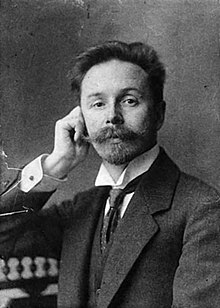
Music #414 - Scriabin

Alexander Scriabin  - top tracks
/skriˈæbɪn/ Алекса́ндр Никола́евич Скря́бин
(1872 – 1915)

* His early work is characterised by a lyrical and idiosyncratic tonal language influenced by Frédéric Chopin.

* Later in his career, Scriabin developed a substantially atonal and much more dissonant musical system.

* Scriabin was influenced by synesthesia, and associated colors with the various harmonic tones of his atonal scale.

A Russian composer and pianist, he is considered by some to be the main Russian Symbolist composer.
Source: Wikipedia

Mysterium 

Selections for Solo Piano

Prometheus / Poem of Fire

Le poème de l'extase / The Poem of Ecstasy

Monday, July 1, 2013

Music #413 - Satie

[eʁik sati] (1866 – 1925)

Eric Satie, a French composer and pianist, was a colorful figure in the early 20th century Parisian avant-garde. 
     An eccentric, Satie was introduced as a "gymnopedist", shortly before writing his most famous compositions, the Gymnopédies. 
     Later, he also referred to himself as a "phonometrician" (meaning "someone who measures sounds"), preferring this designation to that of a "musician".

The Gymnopédies 

- 3 short piano compositions, sharing a common theme and structure. 
     Collectively, the Gymnopédies [dances of nude men, in ancient Greek religious ceremony] are regarded as an important precursor to modern ambient music — gentle yet somewhat defying the classical tradition. 

Source: Wikipedia

Trois Gnossiennes

- for your further relaxation


Alice Sara Ott plays
Gnossienne No. 1,
Gymnopédie No. 1,
& Gnossienne No. 3


Music #412 - Ravel

Maurice Ravel

(1875 – 1937)

A French composer known especially for his melodies, orchestral and instrumental textures and effects. 

Along with Claude Debussy, he was one of the most prominent figures associated with Impressionist music

Ravel's piano compositions demand considerable virtuosity from the performer, such as 
Jeux d'eau
Miroirs
Le tombeau de Couperin and 
Gaspard de la nuit

His orchestral music, including Daphnis et Chloé and his arrangement of Modest Mussorgsky's Pictures at an Exhibition, use a variety of sound and instrumentation. 


Ravel is perhaps known best for his orchestral work Bolérowhich he considered trivial and once described as ... 


was completed for an Austrian pianist who had lost his right arm during WWI.
* abridged version
* full version

Source: Wikipedia


Music #411 - Debussy

["de-bu-SEE"]  [klod dəbysi]
(1862 – 1918, French)

A French composer, he, along with Ravel, was one of the most prominent figures associated with Impressionist music.


《牧神的午後前奏曲》(commonly known by its French title Prélude à l'après-midi d'un faune [pʁelyd a lapʁɛmidi dœ̃ fon])
     A faun (top-half man, bottom-half goat) goes for an adventure in the afternoon: a fantasy.
    The work is called a prelude because Debussy intended to write a suite of three movements – Prelude, Interlude, and Final Paraphrase – but the latter two were never composed.


La mer / The Sea  

a 27-minute version


Trois Nocturnes

№1  Nuages / Clouds
№2  Fêtes / Festivals
№3  Sirènes / Sirens
[bɛʁɡamask]
Debussy was travelling in northern Italy, whose outstanding scenery inspired his composition of Suite Bergamasque, which consists of 4 movements
    The 3rd movement, “Moonlight” or "Clair de lune" in French, is the most well-known and well-received:
piano
violin & piano


The Two Arabesques (Deux Arabesques) 

- for piano
Arabesque № 1 - Andantino con moto (- Leezy on piano)
Arabesque № 2 - Allegretto scherzando


Source: Wikipedia


Music #410 - THE EARLY 20th CENTURY

A great book on ...
THE GREAT COMPOSERS
written by Wendy Thompson
published by Hermes House

The Early 20th Century

Music Sets #411 - 439


Music in a New Framework:-

* Impressionism in music
          Composers realized that they need no longer be subject to the tyranny of traditional tonality
           - a system that had lasted for 400 years. One pioneer was Debussy.

* Atonality
          The "12-note system" of the chromatic scale used in various ingenious ways

* Nationalism
          Musical nationalism continued to flourish.

* Music and politics
          The two world wars
          The economic depression  (giving rise to small chamber ensembles)
          Exporting Jazz from the USA to Europe
          The rise of Nazi Germany (central Europe was emptied of Jewish composers and performers)

Source: The Great Composers

Tuesday, June 11, 2013

Music #409 - Other Composers of the Era

Alexander Glazunov
(1865 – 1936)

A Russian composer, Glazunov successfully reconciled nationalism and cosmopolitanism in Russian music.
Violin Concerto
Saxophone Concerto


Karol Szymanowski
[ˌkarɔl ʂɨmaˈnɔfskʲi]  (1882 – 1937)

A Polish composer and pianist.
* Stabat mater 聖母悼歌


Hugo Wolf
(1860 – 1903)

An Austrian composer of Slovene origin, particularly noted for his art songs/liedertop tracks
Italian Serenade. - his best-known work, apart from songs


Max Bruch
(1838 – 1920)

A German composer and conductor, he is remembered today chiefly for three works:
* Violin Concerto No.1
* Scottish Fantasy   - 6 minutes by Vanessa Mae
* Kol Nidrei - Part 1   - Part 2


César Franck 

(1822 – 1890)

A musician who worked in Paris during his adult life, he was born at Liège  in what is now Belgium.  He is mainly remembered for his 
* Symphony in D minor
* Symphonic Variations  (a compact piano concerto, with 6 variations and a finale)
* Piano Quintet
* Violin Sonata  (one of the most popular Romantic)
* Panis angelicus
Prélude, Choral, et Fugue  (solo piano)


Vincent d'Indy
​[vɛ̃ˈsɑ̃ dɛ̃ˈdi] (1851 – 1931)

A French composer and teacher.
* Symphonie sur un chant montagnard français / Symphony on a French Mountain Air


Paul Dukas 
(1865 - 1935)

A French composer, critic, scholar and teacher.

The Sorcerer's Apprentice / L'apprenti sorcier
It is the most performed and recorded of Dukas's works, because of its notable appearance in the Walt Disney 1940 animated film Fantasia.

Fantasia 2000 updates Fantasia 1940
Fantasia 1940 & Fantasia 2000


The Sorcerer's Apprentice (2010 film)


Charles Villiers Stanford
(1852 – 1924)

Sir Charles Villiers Stanford was an Irish composer, music teacher .... 

In 1882, aged 29, he was one of the founding professors of the Royal College of Music, where he taught composition for the rest of his life. From 1887 he was also the professor of music at Cambridge. 

Among his pupils were rising composers whose fame went on to surpass his own, such as Gustav Holst and Ralph Vaughan Williams.


Hubert Parry
(1848 – 1918)

Sir Charles Hubert Hastings Parry was an English composer, teacher and historian of music.


As a composer he is best known for 
* the choral song "Jerusalem",

* the coronation anthem "I was glad"   - music starting at (0:32),  

* the choral and orchestral ode "Blest Pair of Sirens",  

* the hymn tune "Repton", which sets the words "Dear Lord and Father of Mankind".


Parry was a contributor to George Grove's massive Dictionary of Music and Musicians in the 1870s and 80s.

In 1883 Parry was professor of composition and musical history at the Royal College of Music, of which Grove was the first head. In 1895 Parry succeeded Grove as head of the College, remaining in the post for the rest of his life. Parry's influence on later composers is widely recognized. 


Source: Wikipedia

Music #408 - Rachmaninoff

Sergei Rachmaninoff  

[sʲɪrˈɡʲej rɐxˈmanʲɪnəf]  (1873 – 1943)

A Russian-born composer, pianist and conductor, he is widely considered one of the finest pianists of his day, and one of the last great composers of Romanticism in Russian classical music.


Rhapsody on a Theme of Paganini
one of his best known works

The piece is a set of 24 variations on Paganini's Caprices No.24 (for solo violin).

Variation 18 [15:20] was adopted in Somewhere in Time (1980 movie), starring spoony Christopher Reeve and prettier-than-Mona-Lisa Jane Seymour:
 

... The movie remained in cinema for 223 days, a record length for Hong Kong at the time, between the period of 12 September 1981 and 22 April 1982.
 
Many girls went watch the movie a few times, and sobbed every time. (Girls dared go alone, as admission was highly priced beyond most color-wolves could afford.)


How Variation 18 varies


Prelude in C-sharp minor


Prelude in G minor


Piano Concert No.1


Piano Concerto No.2  

* I. Moderato
* II. Adagio sostenuto - Più animato
* III. Allegro scherzando
Totaling 30 minutes

Yuja Wang
Anna Fedorova


Piano Concerto No.3  

- aka "Rach 3"
* Mvt.1 Allegro ma non tanto
* Mvt.2 Intermezzo: Adagio
* Mvt.3 Finale: Alla breve

Famous for its technical and musical demands on the performer,
as dramatized in the Shine movie:
Training
Playing


Symphony No.1  

The performance was a disaster. 
Rachmaninov suffered a nervous breakdown, and could not compose anything for 3 years. 


Symphony No.2  

* Mvt.1 Largo - Allegro moderato
* Mvt.2 Allegro molto
* Mvt.3 Adagio
* Mvt.4 Allegro vivace.

Source: Wikipedia