Saturday, August 10, 2013

Music #442 - Britten

Benjamin Britten 
(1913 – 1976)

An English composer, conductor and pianist, Britten was a central figure of 20th-century British classical music, with a range of works including opera, other vocal music, orchestral and chamber pieces. 

His best-known works include 

The Young Person's Guide to the Orchestra 
* Peter Grimes opera  (especially Four Sea Interludes)
* War Requiem  (plus a dumentary)

Source: Wikipedia
= = = = =
Bonus:
Variations on a Theme of Frank Bridge
Simple Symphony
       Mvt.1 Boisterous Bourrée
       Mvt.2 Playful Pizzicato   (most famous)
       Mvt.3 Sentimental Sarabande
       Mvt.4 Frolicsome Finale

Music #441 - Shostakovich

Dmitri Shostakovich  

[ˈdmʲitrʲɪj ʂəstɐˈkovʲɪt͡ɕ]/[Дмитрий Шостакович]  (1906 – 1975)

A Soviet Russian composer and pianist, Shostakovich was a prominent figure of 20th-century music.  


The Second Waltz  (aka Russian Waltz)

- music to the Russian film The First Echelon (1955–1956)
* dubbed to a Fanfan movie clip
André Rieu
* ballroom
* dubbed to a War and Peace movie clip
Come Waltz with Me  dubbed to a War and Peace movie clip


Symphony No.5   
* Mvt.4 of 4   Allegro non troppo
Zhilyayev regarded this a genius' work, before Z disappeared on earth.


Symphony No.7 "Leningrad"

When Nazi started to bomb Leningrad, S was reinstated and made a rep of resistance. He released this symphony, which was spread to perform in UK and US in weeks. Leningrad was surrounded for 900 days and suffered more than 1 million deaths.


Symphony No.8

* Mvt.3 of 5   Allegro non troppo


String Quartet No.8

 
(L) Music for (R) the "Five Days Five Nights" (1960 movie) re post-Allied-bombing of Dresden.


Song of the Forests

Written to celebrate the forestation of the Russian steppes following the end of World War II, the oratorio has 7 movements:
- When the War Was Over
- The Call Rings Throughout the Land
- Memory of the Past
- The Pioneers Plant the Forests
- The Fighters of Stalingrad Forge Onward
- A Walk into the Future
- Glory
Part 1 of 3


Suite for Jazz Orchestra No. 2


RESTRICTED TO ADULTS: 

Lady Macbeth of Mtsensk opera (1992 version): 

After 177 full houses for 2 years starting 1934, this opera was criticized by Pravda, S lost his jobs and had most of his "muddle instead of music" banned.

Source: Wikipedia

Friday, August 2, 2013

Music #440 - MUSIC SINCE WORLD WAR II

A great book on ...
THE GREAT COMPOSERS
written by Wendy Thompson
published by Hermes House

Music since World War II

Music Sets #441 - 449
(Please refer to the book for more composers in this period;
modern composers are not targets within my project scope.)


Modern Music:-

There are no more "schools" of composition: each composer now strives to find an original and entirely individual voice.

 * Minimalism
          Music relies on repetitive rhythmic and melodic ostinati for its hypnotic effect.

* Electronic music
          The use of electronic instruments, amplification and sampling has become widespread.

* Female composers
          Female composers began to challenge the traditional male hegemony in composition, 
          ... particularly in TV and film music.
    
Source: The Great Composers

Wednesday, July 24, 2013

Music #439 - Other Composers of the Era


Kurt Weill
(1900 – 1950, German)

Weill held the ideal of writing music that served a socially useful purpose.

With Bertolt Brecht, he developed productions such as his best-known work Die Dreigroschenoper (The Threepenny Opera), a Marxist critique of capitalism, which included the ballad "Mack the Knife". 

September Song


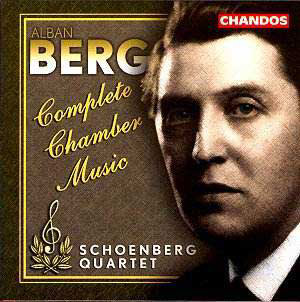
Alban Berg 
(1885 – 1935, Austrian)

H was a member of the Second Viennese School with Arnold Schoenberg and Anton Webern (see below).
                      
* Wozzeck opera
* String Quartet
* Lyric Suite
* Lulu
* Violin Concerto


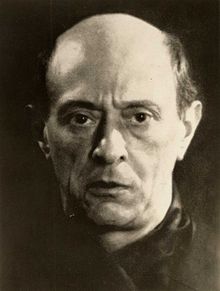
Arnold Schoenberg
(1874 – 1951, Austrian)

Leader of the Second Viennese School

Schoenberg's approach, both in terms of harmony and development, is among the major landmarks of 20th-century musical thought.

* Verklärte Nacht
* Gurrelieder
* Chamber Symphony No. 1
* 3 piano pieces
* 5 orchestral pieces
* Pierrot Lunaire
* Moses und Aaron


Anton Webern
(1883 – 1945, Austrian)

A composer and conductor, he was a member of the Second Viennese School. 

As a student and significant follower of Arnold Schoenberg, he became one of the best-known exponents of the twelve-tone technique.

Symphonie
Concerto for Nine Instruments
Cantata No. 1&2
String Quartett
Piano variations
Variations for Orchestra


Charles Ives
(1874 – 1954, American)
He is one of the first American composers of international renown, though his music was largely ignored during his life. 

Over time, Ives came to be regarded as an "American original". He combined the American popular and church-music traditions of his youth with European art music, and was among the first composers to engage in experimental music.

* Holidays Symphony
* Central Park in the Dark
* Three Places In New England
* Variations on America
* Sonata No. 2 "Concord"


Percy Grainger
(1882 – 1961)

An Australian-born composer and pianist, Grainger played a prominent role in the revival of interest in British folk music in the early years of the 20th century. 

He also made many adaptations of other composers' works. Although much of his work was experimental and unusual, the piece with which he is most generally associated is his piano arrangement of the folk-dance tune "Country Gardens".                                        

* The Warriors
* Handel in the Strand
* A Lincolnshire Posy


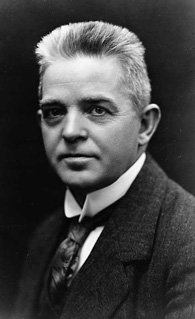
Carl Nielsen 
[kʰɑːl ˈnelsn̩]  (1865 – 1931)

Nielsen is widely recognized as Denmark's greatest composer.

Carl Nielsen is especially admired for his six symphonies, his Wind Quintet and his concertos for violin, flute and clarinet.

In Denmark, his opera Maskarade and a considerable number of his songs have become an integral part of the national heritage.      


Zoltán Kodály
[ˈkodaːj ˈzoltaːn]  (1882 – 1967)

A Hungarian composer, ethnomusicologist, pedagogue, linguist, and philosopher, he is best known internationally as the creator of the Kodály Method.

* Háry János Suite
* Dances of Galánta
* Concerto for Orchestra


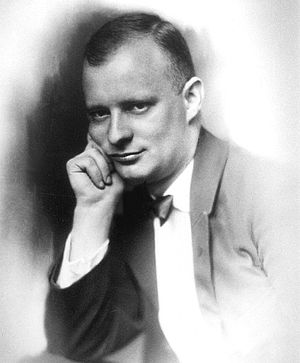
Paul Hindemith  - top tracks
(1895 – 1963)

Hindesmith was a German-born American. 

His notable compositions include:
* opera Mathis der Maler / Matthias the Painter
* Das Marienleben The Life of Mary - song cycle  for soprano and piano, based on poems by Rainer Maria Rilke.


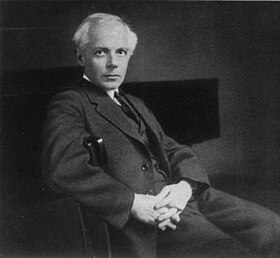
Béla Bartók
[ˈbeːlɒ ˈbɒrtoːk]  (1881 – 1945)

'Bartok was the greatest Hungarian composer since Liszt. 
He and Kodaly put Hungary on the international musical map.'

Through his collection and analytical study of folk music, 
he was one of the founders of ethnomusicology 
-- the study of the music of the world.
* Concerto for Orchestra
* Duke Bluebeard's Castle


Leoš Janáček
[ˈlɛoʃ ˈjanaːt͡ʃɛk]  (1854 – 1928)

Considered one of the most important Czech composers, he was inspired by Moravian and all Slavic folk music to create an original, modern musical style.

Jenůfa  - often called the "Moravian national opera"
finale
2-hour full version

Janáček's later works are his most celebrated:
* the symphonic poem Sinfonietta,
* the oratorio Glagolitic Mass  - Saints Cyril created Glagolitic alphabet for Orthodox bible,
* the rhapsody Taras Bulba,
* two string quartets,   No.1    No.2
* other chamber works and operas
          From the House of the Dead opera / Z mrtvého domu
          The Makropoulos Affair opera / Věc Makropulos


Frederick Delius 
(1862 – 1934)

An English composer.

A Village Romeo and Juliet   
a full 2-hour version


Ferruccio Busoni
(1866 – 1924)

An Italian composer, pianist, editor, writer, piano and composition teacher, and conductor.

Arlecchino opera
a 2-minute sample
a full version

Doktor Faust opera
a 3-minute sample

Music #438 - The King's Singers

The King's Singers  - top tracks
- Live at the BBC Proms


1. La Bell' Si Nous Étions - Francis Poulenc [1.13]
2. La Belle Se Sied Au Pied De La Tour - Francis Poulenc [1.34]
3. Clic, Clac, Dansez Sabots - Francis Poulenc [1.58]
4. Pilons L'orge - Francis Poulenc [0.42]
5. Ah! Mon Beau Laboureur - Francis Poulenc [3.34]
6. Les Tisserands - Francis Poulenc [1.56]
7. Scenes In America Deserta - John McCabe [14.11]
8. La Guerre - Clement Janequin [7.11]
9. Dessus Le Marche d'Arras - Orlande de Lassus [1.28]
10. Toutes Les Nuitz - Orlande de Lassus [3.00]
11. Il Est Bel Et Bon - Pierre Passereau [1.03]
12. Phillis Is My Only Joy - John William Hobbs [1.49]
13. The Little Green Lane - Trad. arr. S.E. Lovatt [2.05]
14. The Goslings - Frederick Bridge [2.47]
15. Greensleeves - Trad. arr. Bob Chilcott [3.11]
16. Blow Away The Morning Dew - Trad. arr. Gordon Langford [1.56]
17. The Turtle Dove - Trad. arr. Philip Lawson [3.30]
18. Widdicombe Fair - Trad. arr. Gordon Langford [3.42]
19. The Long Day Closes - Arthur Sullivan [4.22]

Music #436 - William Walton

(1902 – 1983)

Sir William Turner Walton OM was an English composer. During a sixty-year career, he wrote music in several genres and styles, from opera to film scores. 

Battle of Britain (1969) movie  - opening scenes         


His best-known works include 
* Belshazzar's Feast  (cantata)
* First Symphony

Legends:

Battle of Britain
* Henry V: Non Nobis and Te Deum
     - Non nobis, non nobis, Domine   /Not to us, not to us, O Lord/
       Sed nomini tuo da gloriam.   /But to thy name give glory./
* Façade (Front) – An Entertainment   
In the story of Belshazzar's Feast, the Jews are in exile in Babylon. After a feast at which Belshazzar, the Babylonian king, commits sacrilege by using the Jews' sacred vessels to praise the heathen gods, he is miraculously killed, the kingdom falls, and the Jews regain their freedom.
Source: Wikipedia

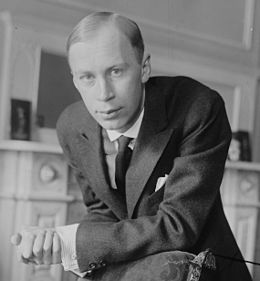
Music #434 - Prokofiev


/prəˈkɒfiɛv/  (1891 – 1953) 

A Russian composer, pianist and conductor who mastered numerous musical genres, Prokofiev is regarded as one of the major composers of the 20th century. 

His best-known works are 

* 5 piano concertos
* 9 completed piano sonatas
* 7 symphonies.


Piano Concert No.1
Martha Argerich & Alexandre Rabinovitch
at "Le festival de la Roque-d'Anthéron"
(an international piano festival) in 2005


The Nazi invasion of the USSR spurred him to compose his most ambitious work, an operatic version of Leo Tolstoy's War and Peace.

= = = = = 

Besides many other works, Prokofiev also composed family favourites, such as 
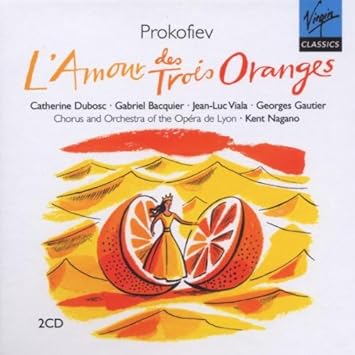
* the March from The Love for Three Oranges, 
* the suite Lieutenant Kijé, 
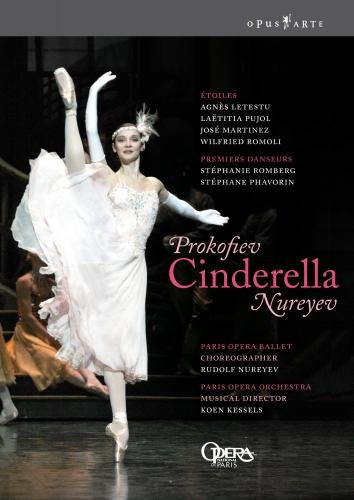
* the ballet Romeo and Juliet,
* Peter and the Wolf.


Love for Three Oranges opera  
March by Itzhak Perlman


Lieutenant Kijé  
This score was composed for the 1934 Soviet film Lieutenant Kijé based on the novel of the same title.
Mvt 3 of 5 Kijé's Wedding
a full suite


Based on Shakespeare's play, it is one of the most enduringly popular ballets. 
Music from the ballet was extracted by Prokofiev as three suites for orchestra and as a piano work.
Suite No.2 - Mvt 1 of 7 - Montagues and Capulets / Dance of the Knights


Peter and the Wolf  

(L) Vancouver Symphony Orchestra
 
(R) Disney Story

Source: Wikipedia