The fresco depicts a barefoot maiden, once back on the bottom of the green water in the act of picking a tree with her right hand that lays white flowers in a kalathos held in her left hand. She wears a yellow tunic which leaves bare the right shoulder and is adorned with a garland on her head and armillary in the right arm.
Merrymaking - Etruscan mural with dance and music (double-pipe and barbiton shown) 470 BCE
Since its discovery, the tomb's frescoes have deteriorated and lost some of their color and detail. In 1949 they were moved to the Tarquinia National Museum in order to to conserve and retouch them (based on the watercolor copies made by Carlo Ruspi shortly after the discovery of the tomb). A triclinium (three-couch) was a formal dining room. On each couch a diner reclined on the left side on cushions while some household slaves served multiple courses rushed out of the kitchen, and others entertained guests with music, song, or dance.
Sarcophagus of Cerviteri Couple It depicts a married couple reclining at a banquet together in the afterlife. There is one in the Louvre in Paris (and another one in the National Etruscan Museum of Villa Giulia, Rome.)
..... made of terracotta which was once brightly painted 1.14 m high by 1.9 m wide - 520 BCE On display at Palais du Louvre, Paris
The portrayal of a married couple sharing a banqueting couch is uniquely Etruscan; in contrast, Greek vases depicting banquet scenes reflect the custom that only men attended dinner parties.
The Revelers Vase(510 BCE) The Grrek vase was painted in the red figure pottery style. Although the vase is in the amphora shape, its purpose is more decorative than functional.
Aphrodite (goddess of love, beauty and sexual desire) - aka "Venus de Milo" - rediscovered in the Greek island of Milos - marble (202 cm high) 200 BCE - Louvre (Paris)
In an example of anasyrma, it depicts a partially draped woman, raising her light peplos to uncover her hips and buttocks, and looking back and down over her shoulder, perhaps to evaluate them. The subject is conventionally identified as Venus (Aphrodite), though it may equally be a portrait of a mortal woman.
- is the largest Bronze Age archaeological site (1500-1450 BCE) on Crete - is considered Europe's oldest city
Dolphin fresco (retouched) A marine scene featuring a school of dolphins composed symmetrically with fish in the interstices and clusters of sponges around the periphery
Bull-leaping
- fresco (80 cm height) c.1500 BCE
- Knossos
An acrobat on a bull with two female acrobats on either side.
Akrotiri is a prehistoric settlement on the Greek island of Santorini (ancient name Thera). The settlement was destroyed in the Theran eruption about 1627 BCE and buried in volcanic ash, which preserved the remains of fine frescoes and many artworks. The site has been excavated since 1967.
Head, torso of female with long tresses, headband, dress with full bodice,
wearing necklaces, wristlets, holding up or accepting a necklace in the right hand. Also on display at the National Archaeological Museum in Athens
A Roman floor mosaic originally from the House of the Faun in Pompeii (an alleged an imitation of Apelles' painting), it depicts a battle between the armies of Alexander the Great and Darius III of Persia.
Alexander Mosaic (House of the Faun, Pompeii)
- mosaic (272 × 513 cm) c.100 BC
- National Archaeological Museum (Naples)
Wall fragments from the Tomb of Nebamun - an Egyptian "scribe and counter of grain" The Tomb of Nebamun, located somewhere in the Theban Necropolis in Egypt, was the source of a number of decorated tomb scenes currently in storage in the British Museum, London. In 2009 the British Museum opened up a new gallery dedicated to the display of the restored 11 wall fragments from Nebamun's tomb, described as one of the Museum's greatest treasures. (1) "Pond in a Garden" wall painting
Pond in a Garden - from the Tomb of Nebamun (Egypt) - fresco (64 x 74 cm) 1350 BCE - British Museum (London)
(2) "Fowling (in the marshes)" fresco
Fowling scene - from the Tomb of Nebamun (Egypt)
- fresco (81 x ? cm) 1350 BCE - British Museum (London)
Nebamun on a boat with wife and daughter, with baton in one hand and 3 birds in the other.
Source: Wikipedia
= = = = = = = = = = Also on display at the British Museum, London:
Weighing of the Heart
Drawn on 40-cm-high papyrus for a funeral chamber Anubis(half-kneeling) attended the weighing scale in the process: a soul associated to a light heart would be allowed to enter the realm of the dead; a heavy (=sinful) heart would be eaten by Ammit (waiting at the bottom right corner).
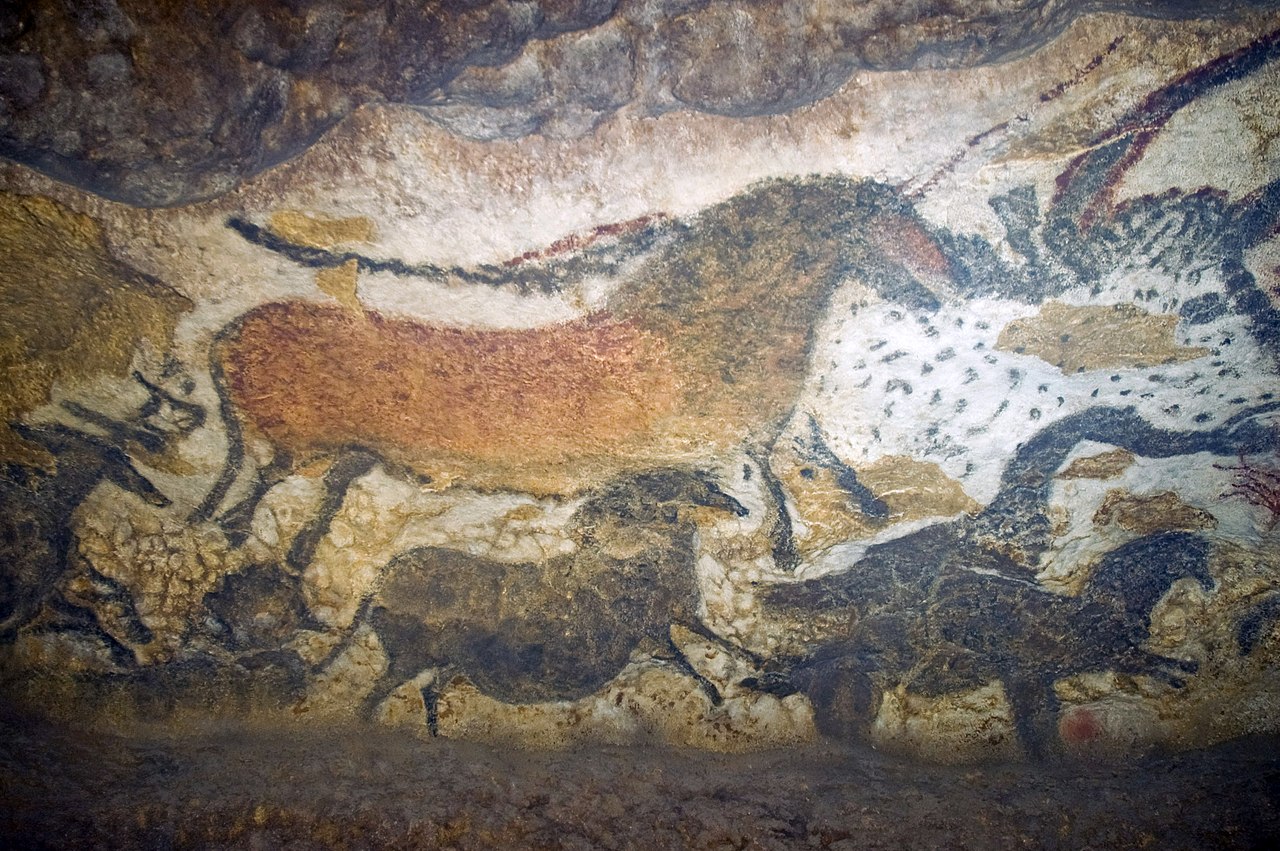
Cave of Altamira(15,000 - 12,000 BCE) Located in northern and mountainous Spain, Altamira is a cave famous for its Upper Paleolithic cave paintings of wild mammals and human hands. The latter might be left by the original painters, as signatures or chops.


.png/1024px-Vesuvius_from_Pompeii_(hires_version_2_scaled).png)


.jpg)