Tuesday, October 28, 2014


Ballet Appreciation Series (2014#8) - Kenneth MacMillan
Kenneth MacMillan
(1) Mayerling
Based on the Mayerling Incident (Jan 1889) where 30-year-old Crown Prince Rudolf of Austria-Hungary (married to Princess Stéphanie of Belgium) shot his 17-year-old beautiful lover Baroness Mary Vetsera, and then himself, in the hunting lodge at Mayerling, 30 miles away from Vienna.
Trailer
(1) Mayerling
Based on the Mayerling Incident (Jan 1889) where 30-year-old Crown Prince Rudolf of Austria-Hungary (married to Princess Stéphanie of Belgium) shot his 17-year-old beautiful lover Baroness Mary Vetsera, and then himself, in the hunting lodge at Mayerling, 30 miles away from Vienna.
Trailer
WARNING: It contains adult and adultery contents:
Episode:
Rudolf was buried in imperial garment, and among his Habsburg ancestors, who had ruled Austria for 600 years. His lover was buried, unnoticed and eventually, in a primitive coffin in an unknown nunnery.
Ballet Appreciation Series (2014#7) - Sylvia
Sylvia ballet uses music by Léo Delibes:
- A shepherd boy is in love with Sylvia (a chaste huntress nymph)
- An evil hunter stalks Sylvia and kidnaps her
- The god of love rescues Silvia for the shepherd
- Diana (goddess of the hunt and chastity) is angry of the love matter because it reminds her of her young love (another shepherd).
- A shepherd boy is in love with Sylvia (a chaste huntress nymph)
- An evil hunter stalks Sylvia and kidnaps her
- The god of love rescues Silvia for the shepherd
- Diana (goddess of the hunt and chastity) is angry of the love matter because it reminds her of her young love (another shepherd).
Sunday, October 26, 2014
Ballet Appreciation Series (2014#6) - Roland Petit
Roland Petit (1924-2011)
Coach introduced 3 ballets choreographed by Roland Petit.
= = = = = = = = = = = = = = = = = = = = = = = =
Carmen (1949) ballet is based Bizet's superb opera of the same name.
Its music is also from the opera. 50 minutes long, not a full-length ballet.
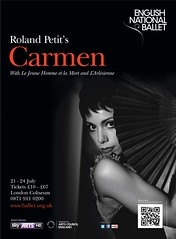 It is a love tragedy between wild Gypsy factory worker Carmen and naïve soldier Don José, in Seville of Spain.
* Part 1
Falling for Carmen, José let her loose from jail, deserted the army, and committed smuggling...
* Part 2
Then, Carmen found a bull-fighter a more exciting lover...
* Part 3
I'd like Bizet's opera version more, though.
= = = = = = = = = = = = = = = = = = = = = = =
Roland Petit choreographed the Chaplin Dances (1991), based on his impressions of Charlie Chaplin in a number of silent movies.
Later, Fuji TV made a 1-hour stage recording called Charlot ("Little Charles"), starring Tamiyo Kusakari and 60-year-old Luigi Bonino.
* Luigi Bonino
* Tamiyo Kusakari - Her husband is the film director, meeting Petit and Chaplin's son in Japan.
* Charlie Chaplin himself
* BGT
= = = = = = = = = = = = = = = = = = = = = = = =
 Pique Dame / The Queen of Spades (2001) ballet, choreographed by Roland Petit, was introduced next.
Only half-an-hour long, it adopted Tchaikovsky's opera of the same name, and Tchaikovsky's Symphony No. 6.
It was about a desperate young man, who would try anything to acquire the superb gambling skills from an aged gambling queen. I'm not impressed.
= = = = =
Petit has many other better choreography masterpieces, such as
* Bizet's L'Arlesienne (1974).
* Ravel's Bolero
Coach introduced 3 ballets choreographed by Roland Petit.
= = = = = = = = = = = = = = = = = = = = = = = =
Carmen (1949) ballet is based Bizet's superb opera of the same name.
Its music is also from the opera. 50 minutes long, not a full-length ballet.
 It is a love tragedy between wild Gypsy factory worker Carmen and naïve soldier Don José, in Seville of Spain.
 * Part 1
Falling for Carmen, José let her loose from jail, deserted the army, and committed smuggling...
* Part 2
Then, Carmen found a bull-fighter a more exciting lover...
* Part 3
I'd like Bizet's opera version more, though.
= = = = = = = = = = = = = = = = = = = = = = =
 |
| Charlie Chaplin (1889-1977) |
Later, Fuji TV made a 1-hour stage recording called Charlot ("Little Charles"), starring Tamiyo Kusakari and 60-year-old Luigi Bonino.
* Luigi Bonino
* Tamiyo Kusakari - Her husband is the film director, meeting Petit and Chaplin's son in Japan.
* Charlie Chaplin himself
* BGT
= = = = = = = = = = = = = = = = = = = = = = = =

Only half-an-hour long, it adopted Tchaikovsky's opera of the same name, and Tchaikovsky's Symphony No. 6.
It was about a desperate young man, who would try anything to acquire the superb gambling skills from an aged gambling queen. I'm not impressed.
= = = = =
Petit has many other better choreography masterpieces, such as
* Bizet's L'Arlesienne (1974).
* Ravel's Bolero
Ballet Appreciation Series (2014#5) - Camille
Coach introduced two ballets based on Camille (or Lady of the Camellias), an 1852 novel and play by Alexandre Dumas, fils.
It was a well-known love story between spoony Armand (a young bourgeois) and glamorous Marguerite (a TB-ridden socialite kept by various lovers).
Both suites are heavy with body languages and facial expressions, accompanied by simple piano music, just like mime
Frederick Ashton (1906-88, British) choreographed the one-scene "Marguerite & Armand" (1963) ballet, which is accompanied by Liszt's piano music and lasts only 30 minutes -- a bit short.
What's after the first 4.5 minutes is ritual.
John Neumeier (1939-, American) choreographed the three-scene "Lady of the Camellias" (1978) suite, which is accompanied by Chopin's piano music and lasts 2 hours. As spoony as Armand, I was head over heels for Marguerite enacted by Sue Jin KANG.
Two hours is long for those who urgently want to see what happens next to the romance, but right for those who enjoy ballet techniques show-off.
Neumeier was especially innovative by incorporating a few scenes of "Manon Lescaut", as play within play, in this suite.
It was a well-known love story between spoony Armand (a young bourgeois) and glamorous Marguerite (a TB-ridden socialite kept by various lovers).
Both suites are heavy with body languages and facial expressions, accompanied by simple piano music, just like mime
= = = = = = = = = = = = = = = = = = = = = = = = = = = = = = = = =
What's after the first 4.5 minutes is ritual.
= = = = = = = = = = = = = = = = = = = = = = = = = = = = = = = = =
John Neumeier (1939-, American) choreographed the three-scene "Lady of the Camellias" (1978) suite, which is accompanied by Chopin's piano music and lasts 2 hours. As spoony as Armand, I was head over heels for Marguerite enacted by Sue Jin KANG.
Two hours is long for those who urgently want to see what happens next to the romance, but right for those who enjoy ballet techniques show-off.
Neumeier was especially innovative by incorporating a few scenes of "Manon Lescaut", as play within play, in this suite.
Thursday, October 23, 2014
Ballet Appreciation Series (2014#4) - Checkmate / Les Noces / Isadora Duncan
In the evening's triple bill, three female choreographers were introduced.
Ninette de Valois (1898-2011, Irish) choreographed this Checkmate (1937) ballet, in which all dancers are dressed as red or black chess-pieces. The idea and music were by Arthur Bliss (1891-1975).
At the end, red loses and the red king is killed by having his waist-bone bent to break by staffs, according to medieval practice.
If you insist on a full version:
Bronislava Nijinska (1891-1972, Soviet Russian) choreographed Stravinsky's Les Noces (The Wedding) music, to become a ballet with vocalists (dance cantata).
Soviet collectivism is apparent, because all dancers dressed in similar ethnic clothes, and did line dance (para para); the marrying couple on the contrary has low-profile roles in the background.
Isadora Duncan (1877-1927, American) was a pioneer in modern dancing, which emphasizes on self-expression, and does not intend to entertain.
* She danced bare-footed, showing big toes on big feet.
* She wore loose garment, not staying in ballerina shape.
* She ran forth and back on stage, telling no stories.
* Her best audience is ballerinas who have suffered from years of harsh training and practice.
Based on his impressions of her dancing, Frederick Aston (1904-1988, British) choreographed "Five Brahms Waltzes in the Manner of Isadora Duncan" (1975):
Please note that waltz here only means triple metre, and not Vienna waltz or that kind.
= = = = =
Ninette de Valois (1898-2011, Irish) choreographed this Checkmate (1937) ballet, in which all dancers are dressed as red or black chess-pieces. The idea and music were by Arthur Bliss (1891-1975).
At the end, red loses and the red king is killed by having his waist-bone bent to break by staffs, according to medieval practice.
The red horse is killed for being soft-hearted.
If you insist on a full version:
Not a romantic classical at all.
= = = = =
Bronislava Nijinska (1891-1972, Soviet Russian) choreographed Stravinsky's Les Noces (The Wedding) music, to become a ballet with vocalists (dance cantata).
Soviet collectivism is apparent, because all dancers dressed in similar ethnic clothes, and did line dance (para para); the marrying couple on the contrary has low-profile roles in the background.
Not the romantic and glamorous kind of ballet
= = = = =
Isadora Duncan (1877-1927, American) was a pioneer in modern dancing, which emphasizes on self-expression, and does not intend to entertain.
* She danced bare-footed, showing big toes on big feet.
* She wore loose garment, not staying in ballerina shape.
* She ran forth and back on stage, telling no stories.
* Her best audience is ballerinas who have suffered from years of harsh training and practice.
Based on his impressions of her dancing, Frederick Aston (1904-1988, British) choreographed "Five Brahms Waltzes in the Manner of Isadora Duncan" (1975):
Subscribe to:
Posts (Atom)