Sunday, February 17, 2013

Music #330 - Bach - sacred music

Johann Sebastian Bach  

(1685 - 1750)  
       

This chorale is the last of the 10 movements in cantata Heart and Mouth and Deed and Life. 
* Piano version  (Myra Hess' version was best-received) 
* Amazing Japanese forest xylophone / 森の木琴

/ Awake, calls the voice to us 
- aka Sleepers Awake  

Freue dich, erlöste Schar, BWV 30  

/ Rejoice, redeemed host 
choirboy, choirgirl, choir master


BWV 55 - church cantata 
/ I, wretched man, a servant to sin

BWV 82 - church cantata 
/ I am content

BWV 229 - motet 

- 6 sacred cantatas to be performed on the 3 days of Christmas, New Year's Day, the Sunday after the New Year, the Feast of the Epiphany


* Tilge, Höchster, meine Sünden 

- "Cancel, Highest, my sins" motet, BWV 1083

Bach copied and arranged Italian master Pergolesi's 1736 Stabat Mater, and used German paraphrase of psalm 51 as text.
- I. “Tilge, Höchster, meine Sünden” (抹去我的過犯, 至高之主) 
soprano+alto 
- IV. “Dich erzürnt mein Tun und Lassen” (我的行事和缺失激怒了你) alto
- XIII. “Amen” chorus


The Passion /《受難曲》 

指耶稣受難前後的事蹟,新約聖經中有四卷福音書 (gospel) 各有描述。西樂之父 J.S.Bach/巴赫 (1685-1750, German Baroque) 跟據福音的記載寫成《聖馬太受難曲》及《聖約翰受難曲》,演出各長三小時及二小時。用德文唱,没有畫面,要熟識經文或有導讀才知唱甚麽和唱到那個情景。


St John Passion

Music #329 - Bach

.

Johann Sebastian Bach  

/BAHkhh/   (1685 - 1750)  
  

A biography (1 hour)


(L) Bach's compositional methods
 
(R) Swinging Bach (1h)

(L) What makes Bach great?
 
(R) a documentary on Bach's “The Art of Fugue”

* on organ:
* on violin in an orchestra   Wow!
* on feet   Wow-Wow!
* digitally

c.f. Davy Jones on organ in a "Pirates of the Caribbean" (2006) movie


Six Cello Suites
Each has a prelude and 5 dance movements.
No.1 - the prelude


The Well-Tempered Clavier 
Two books, each with 24 preludes and fugues 
(for all 24 major and minor keys) 


Goldberg Variations 

Work for harpsichord:
(L) an aria plus 30 variations 


In 'The English Patient' (1996 movie), 
Aria was what she played on a piano, 
slanted by 45 degrees, among rubble.


Concerto for 4 Pianos 

III. Allegro


The Preludio demands advanced bowing technique and consists almost entirely of semiquavers (i.e. sixteenth notes).

* Vanessa Mae on violin


BWV 1060 - Violin Concerto 
BWV 1052 - Harpsichord Concerto I - played on a piano 


(L) Frederick the Great, a skilled flautist, performed for his courtiers under the expert guidance of his tutor, Johann Quantz (1697-1773, German) standing far right.

(R) Bach meets Frederick the Great


Music #328 - Dietrich Buxtehude

Dietrich Buxtehude

[ˈdiːtəʁɪç bʊkstəˈhuːdə] (c.1638 – 1707)

A German-Danish organist and composer of the Baroque period. 

His organ works represent a central part of the standard organ repertoire and are frequently performed at recitals and in church services. He composed in a wide variety of vocal and instrumental idioms, and his style strongly influenced many composers, including J.S. Bach. 

St. Mary's Church
He was organist at St. Mary's Church (Marienkirche) in Lübeck for nearly 40 years. His organ works - Lutheran chlorales, wide-ranging improvisatory preludes, and the ostinato pieces - inspired young J.S. Bach, who walked (300 km) from Thuringia to Lübeck just to hear him play in the winter of 1705-6.

Organ at Marienkirche
Today, Buxtehude is considered one of the most important German composers of the mid-Baroque.


Preludes and toccatas  

The 19 organ praeludia (or preludes) form the core of Buxtehude's work and are ultimately considered his most important contributions to the music literature of the 17th century.


Chorale settings  

- top tracks
There are over 40 surviving chorale settings by Buxtehude, and they constitute the most important contributions to the genre in the 17th century.

Abendmusiken (evening concerts)
 - church concerts on the 5 Sundays before X'mas,
 just after the afternoon service  

Ostinato works  

The 3 ostinato bass works Buxtehude composed — 2 chaconnes (夏康舞曲-源於西班牙的優美舞蹈) and 1 passacaglia (巴沙加牙舞曲) — not only represent, along with Pachelbel's six organ chaconnes, a shift from the traditional chaconne style, but are also the first truly developed north German contributions to the development of the genre.

chaconne                                                 passacaglia
 

Membra Jesu Nostri 

/ The Limbs of our Jesus
- full title: Membra Jesu nostri patientis sanctissima / The most holy limbs of our suffering Jesus
- this work is known as the first Lutheran oratorio
- a cycle of 7 cantatas composed by Buxtehude in 1680


Source: Wikipedia


Saturday, February 16, 2013

Music #327 - Johann Pachelbel

Johann Pachelbel 

[ˈjoːhan ˈpaxɛlbəl]  (1653 – 1706)

Canon is a polyphonic technique in which several voices play the same music, entering in sequence. 

In Pachelbel's Canon, there are 3 voices (violins) engaged in canon, plus an independent 4th voice, the basso continuo. The latter plays a simple passage of 8 notes repeated 54 times.

* a funny version

* a voicy version

It experienced a tremendous surge in popularity during the 1970s, probably due to a recording by Jean-François Paillard in 1970.
* a popular version
- Jean-François Paillard Chamber Orchestra

Now one of the most recognized and famous baroque compositions, it has in recent years become extremely popular for use in weddings.
* How Where When - a lovely version


* a sleepy version

* a father's version

* a courageous version - in “My Sassy Girl / 엽기적인그녀” (2001 Korean movie)

* a digital version - the bass hand doing continuo 

* an impossible version


Magnificat Figures

Pachelbel wrote several different settings of the Magnificat, which plays an important role in the Protestant liturgy of the vespers services.  


Music #326 - Vivaldi

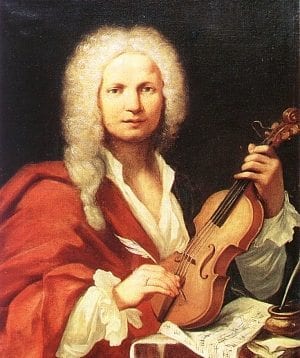
Antonio Vivaldi

(1678–1741, Italian)
- nicknamed 'il Prete Rosso' ('The Red Priest') because of his red hair

Vivaldi was a priest, virtuoso violinist and composer. His influence during his lifetime was widespread over Europe.  He is recognized as one of the greatest Baroque composers, known mainly for composing concertos as well as sacred choral works and operas.  

In 1703 he obtained a post at the Pio Ospedale della Pietà,
an institution for abandoned (though highly talented) girls,
where he taught and earned his students international fame.


The Four Seasons 

is Vivaldi's best-known work, and is among the most popular pieces of Baroque music. It is a set of 4 violin concertos, each of which has 3 movements (fast-slow-fast). A performance of each concerto may take about 10 minutes. 

At the time of writing The Four Seasons, the modern solo form of the concerto had not yet been defined (typically a solo instrument and accompanying orchestra). Vivaldi's original arrangement for solo violin with string quartet and basso continuo helped to define the form.

Why you should listen to Vivaldi's Four Seasons
                                                          
* Concerto No. 1 in E major, "La primavera" / Spring

* Concerto No. 2 in G minor, "L'estate" / Summer
 

* Concerto No. 3 in F major, "L'autunno" / Autumn

* Concerto No. 4 in F minor, "L'inverno" / Winter
 
(R) a digital display of 1st movement


Some of the unconventional variations:-


Spring - (concert grand) piano quartet
 

Summer - "Storm"


Autumn
 

Winter
 
Wintersun 
- Bond's abridged remix of Winter


= = = = =

Gloria, RV 589

- aka Vivaldi Gloria, due to its outstanding popularity
- the better known setting of the Gloria
- it has 12 movements.
VII. Domine Fili Unigenite (聖父的獨生聖子) 


Nulla in mundo pax sincera

(null sincere peace on Earth)
- a devotional prayer to Jesus and His peace.

= = = = = 

Concerto for Lute


Six Flute Concertos, Op.10

(L) Flute Concerto No.2 - La notte / The night 
 
(R) Flute Concerto No.3 - Il cardellino / The goldfinch / 金翅雀


Double Trumpet Concerto in C, RV 537


Concerto for Two Cellos in g, RV 531


Recorder Concerto

(L) RV 441          (R) RV 443


Music #325 - Henry Purcell

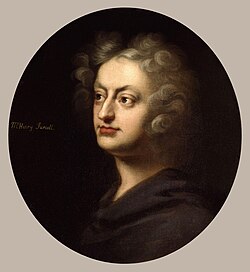
Henry Purcell 

/ˈpɜrsəl/   (1659 – 1695)

England produced no composer of European stature until the brilliant but tragically short-lived Henry Purcell.

Although incorporating Italian and French stylistic elements into his compositions, Purcell's legacy was a uniquely English form of Baroque music.


Dido and Aeneas 

- The story of the three-short-act opera is based on Book IV of Virgil's Aeneid. It recounts the love of Dido, Queen of Carthage, for the Trojan hero Aeneas, and her despair when he abandons her.


King Arthur  

- an adaptation of Shakespeare's A Midsummer Night's Dream


Rejoice in the Lord alway  


Hail, bright Cecilia!  

- Ode for St. Cecilia's Day


Te Deum / Thee, O God


Jubilate Deo / Joy to God


I gave her cakes

- a secular catch (where the same music is sung by each singer in turn)
- this one on a theme of drinking and flirting 


Come Ye Sons of Art 

- Birthday Ode for Queen Mary II


Music for the Funeral of Queen Mary II
William III (1650-1702) and his wife Mary II (1662-94) reigned jointly as King and Queen of England (1689-1702).


This music was also played at Purcell's funeral. He was buried at the foot of the organ in the Westminster Abbey.


Music #324 - Arcangelo Corelli

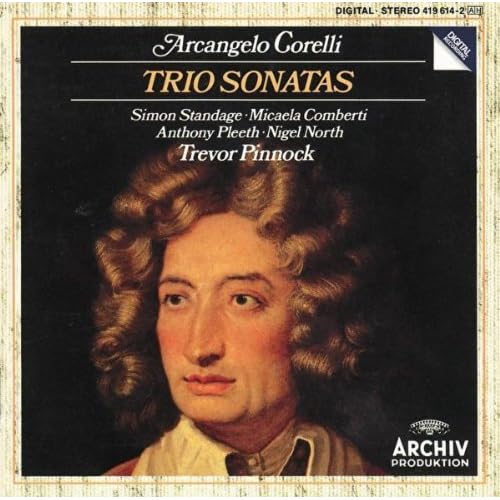
Arcangelo Corelli  

(1653 – 1713, Italian)

Corelli was the most famous violinist-composer of the Baroque era, and one of the most influential after Monteverdi.


* 4 sets of 12 trio sonatas  (for 2 violins and continuo)
   = 24 trio sonate da chiesa (church); 
   + 24 trio sonate da camera (chamber); 
e.g. Op.4 No.9


* 12 solo sonatas  (for violin and continuo)
   = 6 sonate da chiesa 
   + 6 sonate da camera 
E.g. Sonate a violino e violone o cimbalo, Op.5, No.12 “La Folia”


* 12 concerti grossi  (for concertino of 2 violins and cello, string ripieno▪, and continuo)
   = 8 concerti da chiesa 
   + 4 concerti da camera
Legend: ▪ripieno is the larger of the two ensembles
E.g. Op.6 No.8
His Opus 6 collection of 12 was published posthumously and considered the epitome of the concerti grosso form.