Monday, March 4, 2013

Music #344 - Beethoven

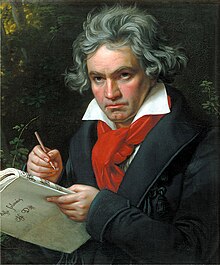
Ludwig van Beethoven  

/BAY-toe-ven/   (1770 – 1827)

He has a long list of compositions.


(L) “Great Composer: Ludwig van Beethoven”
 
(R) “Immortal Beloved” (1994 movie) condensed


- B's only opera
- The jailer's daughter is in love with a jail worker, who is really a woman in disguise, looking for her husband illegally held in jail by the prison governor .....
Mir ist so wunderbar (A wondrous feeling fills me) quartet


Missa Solemnis  


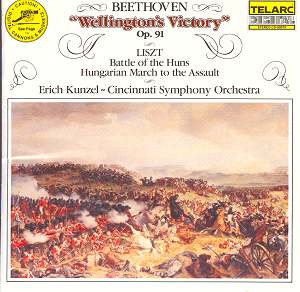
Wellington's Victory

... over (Napoleon's elder brother) Joseph Bonaparte's forces at the Battle of Vitoria in Spain, 1813.
 
(R) video borrowed from Waterloo (1970 movie)

It uses older themes, such as
* "Rule Britannia," and 
– the tune now known as 
Source: Wikipedia
Extra:
** Marlborough is the name of an English general (an ancestor of Winston Churchill) who fought against the French at the Battle of Malpaquet in 1709, during the reign of Louis XIV.

Documentary - The Iron Duke of Wellington


Music #343 - Mozart

Wolfgang Amadeus Mozart   
/MOAT-sart/

Sets #100 to #192 are especially put up for Mozart.
Click here to start with Sets #100.


A recommended short-list:

OPERAS
* The Marriage of Figaro
* Don Giovanni
* Abduction from Seraglio
* The Magic Flute

SYMPHONIES
* No.40   - aka the 'Great G minor symphony'
* No.41   - aka the 'Jupiter' symphony

SERENADES
* Serenade for strings in G major   - aka 'Eine kleine Nachtmusik'
* Divertimento in D   - for oboe, two horns & strings in D major

CONCERTOS
* Concerto in C for flute, harp & orchestra
* Piano Concerto No.20
* Piano Concerto No.21
* Clarinet Concerto in A

CHAMBER MUSIC
* Clarinet Quintet in A

SONATAS
* 19 piano sonatas   - starting with Piano Sonata No.4
* 42 violin sonatas   - starting with Violin Sonata No.21

Music #342 - Haydn - Symphonies

Joseph Haydn 

[ˈjoːzɛf ˈhaɪdən] (1732 - 1809, Austrian)

- the "Father of the Symphony", although he did not invent the form
- his 108 works in the genre pioneered its evolution, from a 3-movement Baroque overture for fewer than 20 players, to the 4-movement form for as many as 60


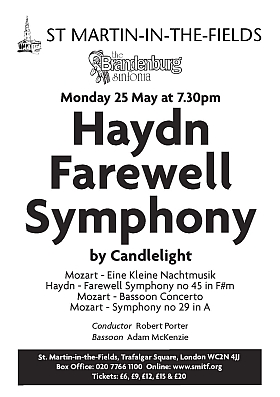
When the tempo is changed from presto (very fast) to adagio (slow) in the middle of the movement (by 4:18), the performers start to leave the stage! 
  
It was by Haydn's design. Their boss made them perform in a summer palace for long, but disallowed them to bring their families along. Aware of his team's grief, Haydn wrote the score so that the performers, one after the other, put out their candles and fare-welled the stage. The boss finally got the message and in the next morning announced leaving the summer palace for home. Thus nicknamed “Farewell” Symphony.


Symphony no. 48   

- nicknamed "Maria Theresia" of Austria, the Holy Roman Empress

It was long thought to have been composed for a visit by the Holy Roman Empress, Maria Theresa of Austria
- The Holy Roman Empress, Maria Theresia of Austria, was superbly beautiful, but she destroyed all her portraits after contracted small pox. One of her beautiful daughters, Marie Antoinette, was married to the dull Prince Louis of France. They were later guillotined during the French Revolution. Their son, nominally Louis XVII, was imprisoned until his death from negligence and illness at the age of 10; he was never officially king.


Haydn did not appreciate those who fell asleep during his performance.  So he humorously designed this piece to wake up the sleepers. Thus nicknamed "Surprise" Symphony.


Symphony no. 100  

- with many breakthroughs and Turkisk military 
- hot at the time
'The nickname "Military" Symphony derives from the second and the fourth movements, which feature prominent fanfares written for C-trumpets and percussion effects.'


Symphony no. 101

* Mvt 2: Andante
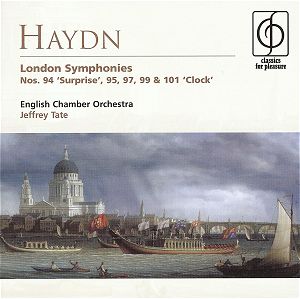
It is popularly known as "The Clock" because of the "ticking" rhythm throughout the second movement.


Symphony no. 104 

"London" Symphony 
- Haydn's last symphony
I. Adagio – Allegro 
(solemn intro, then lyrical allegro)
II. Andante
(full orchestra, then gentility)
III. Menuetto and Trio: Allegro
(frequent syncopations, surprises; orchestral timber in Trio) 
IV. Finale: Spiritoso
(Croatian folk tune & London street seller's cry, joyful end)

(12 of Haydn's later symphonies are known collectively as the “London” Symphonies.)


Source: Wikipedia


Haydn on harpsichord at left bottom corner
At age of 77, Haydn died shortly after Napoleon’s French army attacked on Vienna.  Napoleon dispatched soldiers to protect Haydn's home.  Two weeks later, a memorial service was held, at which Mozart's Requiem was performed.  Mozart and Haydn appreciated each other.

Music #341 - Haydn

[ˈjoːzɛf ˈhaɪdən]  (1732 - 1809, Austrian)

- a key figure in the evolution of the Classical style
- influenced Mozart and taught Beethoven
- established the standard forms of the symphony, sonata, and string quartet
- the "Father of the String Quartet", a genre in which each instrument was equal and independent 


String Quartet No.32 

(Opus 33, No.3)
- aka "The Bird"
I (of 4)  Allegro moderato:
The first movement opens with a melody in the first violin featuring repeated notes. Grace notes are inserted between the repeated notes which gives the melody a "birdlike quality" and hence gives the quartet its nickname.


String Quartet No.62  

(Opus 76, No.3)
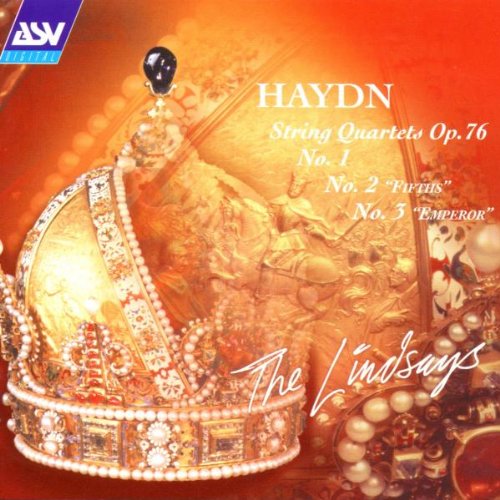
- aka "Emperor" / "Kaiser" Quartet


II (of 4)  Poco adagio; cantabile
In this movement, Haydn quotes the melody from "Gott erhalte Franz den Kaiser" / "God Save Emperor Francis", an anthem he wrote for Emperor Francis II. 

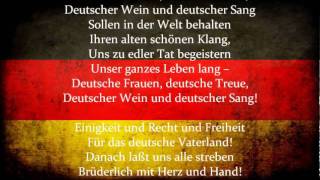
- This same melody is also used in the German national anthem, Das Deutschlandlied.  


String Quartet No.63

(Opus 76, No.4) 
- aka “Sunrise”


Violin Concerto No. 4 

* I (of 3)  Allegro moderato
* transcribed for cello


III (of 3)  Allegro molto: 


Trumpet Concerto in Eb

(L) III (of 3)  Allegro (rondo)
 
(R) full concert


(Hob. XVI/52, L. 62)
- the last of Haydn's piano sonatas
- widely considered his greatest
* “English” Sonata - solo piano:


The Creation  

- The creation of the world as described in the biblical Book of Genesis and in Paradise Lost
- his greatest work, and with intimate lyricisn
 - 2:40


Source: Wikipedia


Music #340 - CLASSICAL PERIOD

A great book on ...

THE GREAT COMPOSERS
written by Wendy Thompson
published by Hermes House


The Classical Period (c.1750-1820)
Music Sets #341 - 349


This period corresponded to a period of classicism in art and architecture
* The flamboyant, heavily ornate Baroque style of architecture gave way to a cooler, more restrained style. So were furniture and paintings.
* It was the age of the Grand Tour, when upper-class young men were dispatched to Italy to study Greek and Roman architecture. 
* In France, there was a Rococo period of transition from the Baroque to Classical styles.


Classical style in music

* The late Baroque composers: the florid, ornamental, technically intricate styles
* Classical music: clarity, restraint, and balance - in symphony, string quartet, solo sonata; instrumental music became more popular than vocal music for the first time
* Four giants in Classical music: Haydn, Mozart, Beethoven, Schubert  - all associated with Vienna - The First Viennese School


Opera

Notably in the works of Gluck and Mozart, plots were chosen for greater dramatic realism, and music was written to serve the drama.


Music's place in society

* The breakdown of the old social order (due to the Napoleonic Wars); the aristocrats were less able to support musicians, who were numbered among the servants.
* Music ceased to be the exclusive preserve of pampered aristocrats or prelates; the Industrial Revolution and colonization creating a large middle class to consume arts and music; musicians were able to earn money from their performances and from publishing their compositions.
* Less musicians were servants of aristocratic/royal families or the church; more as self-employed.


Source: The Great Composers 


Sunday, February 17, 2013

Music #339 - Some Other Composers

Some Other Composers in the Baroque Era


ITALY


Giacomo Carissimi 

(1605 – 1674)

- one of the most celebrated masters of the early Baroque, or more accurately, the Roman School of music.

** Jephte (1648) - oratorio (神劇)
* 拉丁語歌詞(oratorio latino) 
* 六聲部及數字低音(basso continuo) * 於劇場舉行首演
(L) “Cantemus omnes Domino” (齊來為主高歌)
 
(R) “Plorate filii Israel” (哭吧,以色列的子民) 


Giuseppe Tartini  

(1692 – 1770) 

An Italian baroque composer and violinist.

“Devil's Trill” Sonata


Alessandro Marcello    

* Oboe Concerto in C minor


Giovanni Battista Pergolesi   

(1710-1736)

A highly talented Italian composer, violinist and organist, who died young (age 26) of TB, he is remembered for:
* La serva padrona / The Servant Mistress - opera buffa / comic opera

* Stabat Mater Dolorosa /聖母瑪利亞悼歌/ Sorrows of Mary during crucifixion of Jesus -  a sacred music

(L) I. Stabat Mater Dolorosa (聖母瑪利亞悼歌) duet
 
(R) IV. Quae moerebat et dolebat (她是何等愁苦悲傷) aria

XIII. Amen

* Querelle des bouffons / Quarrel of the Comic Actors
'In the early 1750s, there was a war of words between admirers of Rameau's traditional French style, and admirers of the newly imported Italian style of Pergolesi. 
        'In the long run, the Italians won, and Rameau's operas finally dropped out of fashion. They were resurrected some 200 years later...'
Source: The Great Composers by Wendy Thompson.


Girolamo Frescobaldi 

(1583-1643)

* II Libro di Toccate / Second Book of Toccatas - Toccata VI
* Fiori musicali / Flowers of Music (organ music for Mass) - Bergamasca 


Francesco Geminiani

(1687-1762)

* Sonatas for Violin, Op.1, No.1 - I. Adagio - Presto


Domenico Paradies 

(1707-1791)
No.6 of 12 “Sonate de gravicembalo”


​[fʁɑ̃swa kupʁɛ̃]  (1668 – 1733)

A French Baroque composer, organist and harpsichordist, working for the courts of Louis XIV and Louis XV. 
        He was known as Couperin le Grand ("Couperin the Great") to distinguish him from other members of the musically talented Couperin family.
        His most famous and extremely influential book, L'art de toucher le clavecin ("The Art of Harpsichord Playing"), contains suggestions for fingerings, touch, ornamentation and other features of keyboard technique.

Pièces de Clavecin

* La visionaire / The Visionary
* La misterieuse / The Mysterious One
* La Monflambert (named after the wife of a local councillor)
* La muse victorieuse / The Victorious Muse


[maʁk ɑ̃.twan ʃaʁ.pɑ̃.tje]  (1643 – 1704)

- circa 1666, he followed Giacomo Carissimi in Italy for 3 years
- active during the reign of Louis XIV, but never achieved a position at Louis XIV's court
- instead, he produced a wide variety of music for theater and church 

* In nativitatem Domini canticum, H.416 (聖誕歌) 
- dramatic motet (oratorio)
- in oratorio latino, i.e. Latin; sounds more pleasant in French Latin
- II. Memorare testament (記住承諾)


GERMANY


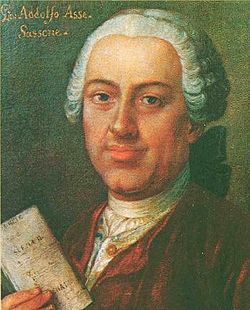
Johann Adolph Hasse  

(1699–1783)

In the mid-1700s, Hasse's operas made him famous throughout Europe. His emphasis on beauty rather than complexity paved the way for the Classical style.
* Artaserse opera
* Cleofide opera
* Lucio Papiro opera

Hasse stages lavish productions at the Dresden Semperoper (opera house built by architect Semper):


(1681 – 1767)
A German Baroque composer and multi-instrumentalist.

* 12 Paris Quartets
* Musique de table
* Bourlesque de Quixotte (Don Quixote) 


BOHEMIAN-AUSTRIA   


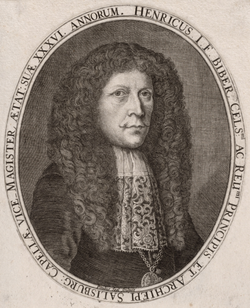
(1644-1704)


ENGLAND


Orlando Gibbons

(1583-1625)

* O Clap Your Hands (8-part anthem):
* The Silver Swan (a madrigal)
* This is the Record of John (a sacred motet)


Jeremiah Clarke

(c.1674-1707)

Trumpet Voluntary / Prince of Denmark's March
(familiar from wedding ceremonies)


Thomas Augustine Arne

(1710-1778)
(L) Rule, Britannia!
 
(R) Thomas & Sally (all-sung? comic opera) 


William Boyce

(1711-1779)
(L) Trio Sonata No.2
 
(R) Solomon

“Praise the Lord O Jerusalem”
Coronation Anthem for George III


Music #338 - Tomaso Albinoni

Tomaso Albinoni (1671-1751)
"a Venetian Baroque composer" 
     
Adagio in G minor  
* a neo-Baroque composition popularly attributed to Albinoni
* but actually composed in 1945 by musicologist and Albinoni biographer Remo Giazotto (1910-1998, Italian), based on a manuscript fragment by Albinoni, uncovered from the ruins of the Saxon State Library at Dresden, caused by Allied bombing in WWII.


(L) @ Basilica of the Pannonhalma Archabbey, Hungary
 
(R) Sissel

Il Divo