Sunday, June 9, 2013

Music #399 - Puccini

Giacomo Puccini

[ˈdʒaːkomo putˈtʃiːni]  (1858 – 1924)
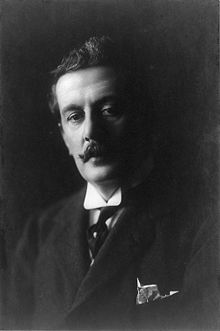
An Italian composer whose operas, including 
- La bohème
Tosca
- Madama Butterfly, and 
- Turandot
are among the most frequently performed in the standard repertoire.

Puccini (plus Mascagni and Leoncavallo) added the new element of "verismo" realism to their operas, telling stories in music that were drawn from everyday life.

Some of his arias, such as 
- "O mio babbino caro" from Gianni Schicchi, 
- "Che gelida manina" / "What a cold little hand" from La bohème, and 
- "Nessun dorma" / "Nobody sleeps" from Turandot, 
have become part of popular culture.


Turandot

* Act 3 Scene 1 - "Nessun dorma"  (with lyrics)
 
(R)  Paul Potts at "Britain's Got Talent" show

* A 3-hour version of Turandot


La bohème

(L)  "Che gelida manina" / "What a cold little hand" 
 
(R)  Musetta's Waltz

(L)  “O soave fanciulla” / “Oh Sweet Girl”
 
(R)  Mimi's death


Madama Butterfly

Cio-Cio San (/cho-cho/ meaning butterfly-butterfly), a 15-year-old Japanese girl in Nagasaki, got married with a visiting US naval officer. As she converted to Christianity, she was abandoned by her relatives and friends. After some romantic time, he left.
She kept waiting for his return. Full of hope, she sings (in Italian!) about "One Beautiful Day" (Un bel dì), the opera's most famous aria and one of the most popular works in the soprano repertoire.
Three years later, the American husband finally returned, only that he was accompanied by his new American wife.
The abandoned 18-year-old butterfly blindfolded her son and slit her own throat, hoping that the American couple would take the mix-blood little son back to US. (Mix-blood was not acceptable then and there in Japan.) 


Tosca - "E lucevan le stelle" /
"And the stars were shining" aria


Music #398 - Verdi - Requiem, etc

Giuseppe Verdi

[dʒuˈzɛppe ˈverdi]  (1813 – 1901)

[Messa da] Requiem

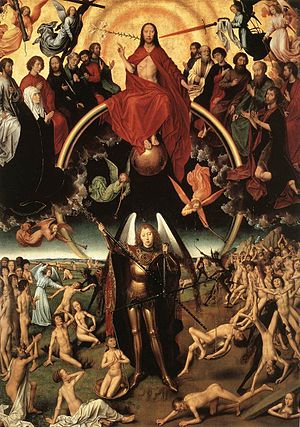
Last Judgment
- Section 2 of 7 
Dies irae (Day of Wrath /
         
The 13th century Latin hymn describes the day of judgment, the last trumpet summoning souls before the throne of God, where the saved will be delivered and the unsaved cast into eternal flames.

The setting includes many highly operatic effects.
The fiery "Dies irae" is one of his most dramatic choruses:
 

A full mass:

Verdi wrote his Requiem in 1874 in memory of Manzoni, the great Italian novelist.
 
Last Judgment
- Pietro Cavallini (1259-c.1330, Italian) 
- fresco, c.1295
- Basilica of Santa Cecilia in Trastevere (Rome)
C: Christ on the throne, surrounded by Angels
L: Mary and six apostles on Christ's right
R: Saint John the Baptist and six apostles on Christ's left


La forza del destino 

/ The Force of Destiny


(Italian: [i ˈvɛspri sitʃiˈljaːni]; "The Sicilian Vespers") 
- a five-act Italian opera originally written in French for the Paris Opéra and translated into Italian shortly after its premiere

Elena gives thanks to all: Mercé, dilette amiche 
/ "Thank you, beloved friends"


Shakespeare's Plays

Verdi drew on Shakespeare's plays for three of his operas: Macbeth, Othello, and Falstaff.

Macbeth 

(L) Witches chorus
 
(R) Lady Macbeth's sleepwalking scene

A full opera (140 minutes)


Music #397 - Verdi - Aida

Giuseppe Verdi

[dʒuˈzɛppe ˈverdi]  (1813 – 1901)

Aida   

"Aïda is an Ethiopian slave to Amneris, daughter of  Pharoah Ramphis. She is in love with the Egyptian general Radamès, who is sent to lead the Egyptian army against Ethiopia.  When Radamès returns victorious, he is given Amneris as his bride. Amonasro, Aïda's father, is captured. He convinces Aïda to find out from Radamès the plan of his next campaign. Ramphis discovers this betrayal and Radamès is condemned to be walled up alive in a tomb, where Aïda joins him. They die together."

* A 2.7-hour version by San Francisco Opera


Selections: 

* Act 1 - Scene 1 - Celeste Aida

* Act 1 - Scene 2 - The grand gate of the city of Thebes
The Grand March
the returning of the victorious army
 (with trophy and spoils, including strong or pretty slaves) to Egypt:


= = = = =

Bonus: 


* flashmob 

The Grand March - with Danny Kaye conducting, facing the audience:


Source: Wiki


Music #396 - Verdi - La Traviata

Giuseppe Verdi

[dʒuˈzɛppe ˈverdi]  (1813 – 1901)

La Traviata 

Based on Alexandre Dumas's play La dame aux camélias, the opera is about courtesan Violetta and her love for Alfredo, which is thwarted by Alfredo's father. Dying of consumption, Violetta does what he asks, only to be reconciled with Alfredo and die in his arms.

A1  Brindisi - "Libiamo ne' lieti calici"  (The Drinking Song)

(L) Angela Gheorghiu & Roberto Alagna in duet
 
(R) Anna Netrebko & Rolando Villazón in duet

(L) except from the La Traviata (1982) movie
 
(R) excerpt from The Three Tenors 
- at The 1994 World Cup (L.A.), with a lyrics video


A1Finale  "È strano! ... Ah, fors' è lui"  (Ah, perhaps he is the one)


A1 Finale  "Sempre libera [degg'io]" (Always free)
- soprano-tenor duet


A2S1  "Di Provenza il mar, il suol chi dal cor ti cancellò?"
(Who erased the sea, the land of Provence from your heart?)


A2S2  Party at Flora's house
Flora calls for the entertainers to perform for the guests:
     (1)  "We are gypsy girls who have come from afar"
     (2) "We are matadors from Madrid
- excerpt from the La Traviata (1982) movie:
     

A3  "Parigi, o cara, noi lasceremo
(We will leave Paris, O beloved)


(L) A full opera (2h)


(R) An excerpt (11m)


= = = = =

* flashmob


(L) "We are gypsy girls who have come from afar"      
 
   (R) a puppy joins in the Drinking Song


Music #395 - Verdi - Il Trovatore

Giuseppe Verdi

[dʒuˈzɛppe ˈverdi]  (1813 – 1901)

Il Trovatore / The Troubadour / 游唱诗人

It is a four-act opera based on the play El trovador (1836).  Today, in its Italian version, it is given very frequently and is a staple of the standard operatic repertoire.

A2S1:  Anvil Chorus / Chorus of Gypsies
The gypsies sing the Anvil Chorus: Vedi le fosche notturne 
/ See! The endless sky casts off her sombre nightly garb...


A2S1:  Canzone: Stride la vampa / "The flames are roaring!"
 
A3S2:  Cabaletta: Di quella pira l'orrendo foco 
/ The horrid flames of that pyre


(L) A full opera, with English subtitles 
 
(R) Explained


= = = = =
Bonus:


Music #394 - Verdi - Rigoletto

Giuseppe Verdi

[dʒuˈzɛppe ˈverdi]  (1813 – 1901)

Rigoletto 

Rigoletto is an opera in three acts. The Italian libretto was written by Francesco Maria Piave based on the play "Le roi s'amuse" by Victor Hugo
        Its tragic story revolves around the licentious Duke of Mantua, his hunch-backed court jester Rigoletto, and Rigoletto's beautiful daughter Gilda.
        The Duke's men kidnap Gilda and take her to the palace. Rigoletto comes looking for Gilda, but when he finds her, she has already been disgraced.
        Rigoletto pays an assassin to murder the Duke. Gilda substitutes herself for the Duke, and is fatally wounded. Rigoletto takes a sack that he believes to contain the Duke's body and finds, instead, his dying daughter.

A full version (120 minutes)
- with English subtitles

Rigoletto was performed in Cairo to celebrate the opening of the Suez Canal.


Some selections:

Act 1 

(L) Scene 1 - A room in the palace
Questa o quella / This woman or that
 
(R) Scene 2 - A street, with the courtyard of Rigoletto's house
Pari siamo! / We are alike!

Act 2 

- The Duke's Palace

(L) * Caro nome / Dearest name
 
(R) * Cortigiani, vil razza dannata / Accursed race of courtiers


Act 3 

- A street outside Sparafucile's house

La donna è mobile / Woman is fickle
 

* Quartet: Bella figlia dell'amore / Beautiful daughter of love


Music #393 - Verdi - Nabucco

Giuseppe Verdi 

[dʒuˈzɛppe ˈverdi]  (1813 – 1901)

An Italian Romantic composer, mainly of opera:
• Verdi is considered with Richard Wagner the most influential composer of operas of the 19th century, and dominated the Italian scene after Bellini, Donizetti and Rossini.
• Verdi developed his art from the influences of the three, through his use of French Grand Opéra forms in operas written for Paris, and, eventually, to the creation of his Shakespearian masterpieces, Otello and Falstaff. Throughout, his originality and fecundity remained unparalleled. 

Some of his themes have long since taken root in popular culture – such as 
- "La donna è mobile" from Rigoletto
- "The Drinking Song" from La traviata
- "Grand March" from Aida
- "The Chorus of the Hebrew Slaves" from Nabucco

= = = = = = = =

Nabucco  

Nabucco follows the plight of the Jews as they are assaulted, conquered, and subsequently exiled from their homeland by the Babylonian King Nabucco.
 
(2h 10m)


Act 1

“Gli arredi festivi” (festive decorations)
The Israelites pray as the Babylonian army advances on their city ("Gli arredi festivi giù cadano infranti" / "Throw down and destroy all festive decorations").


Act 3

The best-known number from the opera is 'Va, pensiero' (the 'Chorus of the Hebrew Slaves')
 
(L) Italian lyrics         (R) English translation

• Then, Italy was colonized by the Austria Empire. Verdi composed this opera to project freedom for Italy.
• During its premiere, the resonated audience encored this chorus three times.
• After the performance, Italians paraded on the streets, holding torches, singing this chorus, and shouting "VIVA VERDI!"
• This chorus became an anthem for the Italian Risorgimento movement for unification. 


In January 1901, at Verdi's funeral procession, 300,000 Italians gathered along the streets of Milan, singing and humming this chorus. 

= = = = =


Source: Wikipedia