Tuesday, June 11, 2013

Music #403 - Sibelius

(1865 – 1957)
A Finnish composer of the late Romantic period. His music played an important role in the formation of the Finnish national identity. 

The core of Sibelius's oeuvre is his set of seven symphonies. 

* Symphony No.1 - Paavo Jarvi conducting Orchestre de Paris
* Symphony No.2 - Leonard Bernstein conducting Wiener Philharmoniker

In addition, Sibelius's best-known compositions include 

* Finlandia  (see below)
* Karelia Suite
* Valse triste
* Violin Concerto in D minor
* The Swan of Tuonela (1 of 4 movements of the Lemminkäinen Suite).
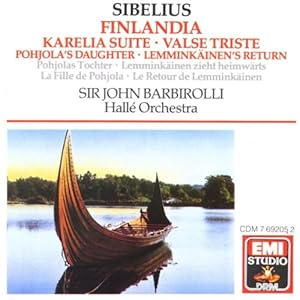
Finlandia is a symphonic poem, composed as a covert protest against increasing censorship from the Russian Empire. 

Most of the piece is taken up with rousing and turbulent music, evoking the national struggle of the Finnish people. 


But towards the end, a calm comes over the orchestra, and the serenely melodic Finlandia Hymn is heard.
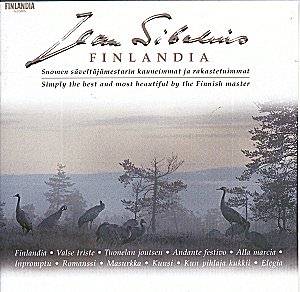
Sibelius later reworked the Finlandia Hymn into a stand-alone piece. This hymn is one of the most important national songs of Finland (though Maamme is the national anthem).
* chorus - a capella
* chorus - with orchestra


History:
In 1809, having been taken over by the armies of Tsar Alexander I in the Finnish War, Finland became an autonomous Grand Duchy in the Russian Empire, until the end of 1917, when the October Revolution in Russia changed the game anew. The right-wing government declared independence on December 6, 1917.

During World War II, Finland fought the Soviet Union twice: in the Winter War of 1939–40 after the Soviet Union had attacked Finland; and in the Continuation War of 1941–44, in which Germany invaded the Soviet Union. 

Finland was never occupied by the Soviet forces and retained its independence, but at a heavy loss of about 93 000 soldiers killed.

Source: Wikipedia

“Finland belonged to Sweden from the 12th until the 19th century, 
and after that it belonged to Russia. 
It became independent in 1917 following the Russian Russian Revolution 
and successfully resisted invasions from both the Soviet Union and Nazi Germany. 
It maintains particularly close relations with the other Nordic countries.”  

Music #402 - Elgar

(1857 – 1934) English composer

Among his best-known compositions are orchestral works including 
* the Enigma Variations, 
* the Pomp and Circumstance Marches (see below), 
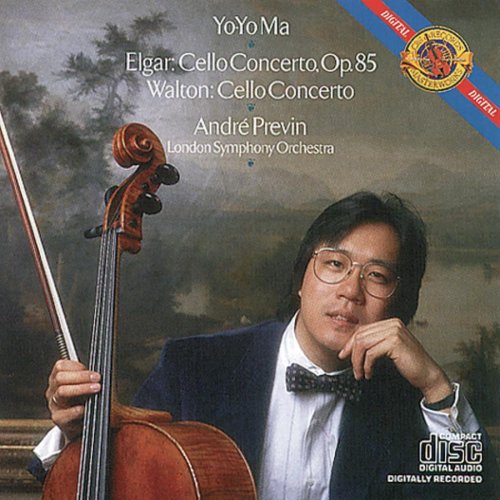
* concertos for violin and cello (see below), and two symphonies. 


- 6 marches glorifying the British Empire

The best known is March No.1, which contains the famous lyrical "Land of Hope and Glory" Trio tune.
* the Trio starts after 1:52
* with coronation lyrics  adapted in Coronation Ode for Edward VII.**

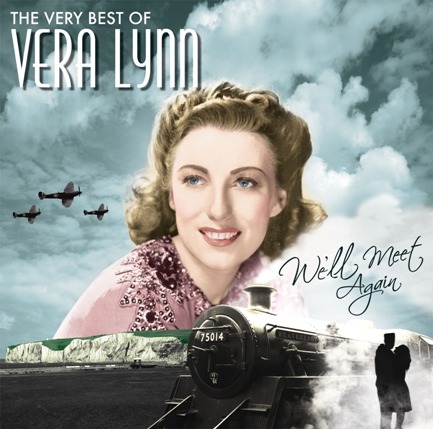
In WW2, Vera Lyn (patriotic singer) sang to enhance the national spirit. - top tracks
* Britain's Got Talent !

(Her Lili Marlene [sang by both sides] and We'll Meet Again were also beautiful.)

We'll meet again again.

In the US, the Trio section is sometimes known as 
* The Graduation March or simply as "Pomp and Circumstance" 
        It is played as the processional tune at virtually all high school and college graduation ceremonies, being usually played when the graduating class or department walks onto the stage.
        This tradition started in 1905, at Yale University, where the Professor of Music Samuel Sanford invited his friend Elgar to attend commencement and receive an honorary Doctorate of Music.
        Elgar accepted, and Sanford organized a large group of musicians to perform 2 parts from Elgar's oratorio:
* The Light of Life
* "Pomp and Circumstance" March No 1 as the graduates and officials marched out,


Salut d'amour 


Cello Concerto


= = = = =
**
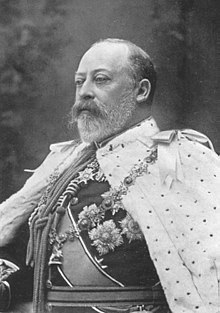
Queen Victoria died in January 1901, at an age of 81.  Her successor Prince Edward, then 59, did not keep fit, after too much food, wine and women. 
       In June 1902, just two days before the planned coronation, Prince Edward was diagnosed with acute appendicitis. Survival chance of operation at that time was low, and much lower for persons of his age and health.  So, the coronation was simply cancelled.
       Surprisingly, he recovered rapidly after the operation.  The next day, Edward was sitting up in bed, smoking a cigar.  Two weeks later, it was announced that the King was out of danger. His coronation was then held in August 1902, at an age of 60. He died at 68. 
       (Prince Edward Road in Kowloon (plus a subway station later) was named after him while he was a long-waiting heir apparent to the throne.)
     

= = = = = 

The Union Jack  

is the national flag of United Kingdom, made of 3 crosses:
- The red cross of Saint George represents England (and Wales). 
- The red diagonal cross of Saint Patrick represents Ireland.  
- The blue cross of Saint Andrew represents Scotland, with the cross counter-changed (that is, white cross X in blue background).

Great Britain = Scotland + Wales + England
United Kingdom = Great Britain + Northern Ireland 

Each of the 4 nations of the UK has its own national days:
- Wales - March 1st - St. David's Day
- Northern Ireland - March 17th - St. Patrick's Day
- England - April 23rd - St. George's Day
- Scotland - November 30th - St. Andrew's Day


Music #401 - Mahler

Gustav Mahler

[ˈɡʊstaf ˈmaːlɐ]  (1860 – 1911)

A late-Romantic Austrian composer and one of the leading conductors of his generation. 


Symphony No. 1

- aka "Titan"
(L) full version
 
(R) IV. 


Symphony No. 2  

- aka "Auferstehung" / "The Resurrection Symphony"
- 5 movements, totaling about 1.5 hours
- Mvt. 5: The first eight lines were taken from the poem "Die Auferstehung" ("The Resurrection") by German poet Klopstock.


Symphony No. 5   

Mvt.4  Adagietto


Symphony No. 8   

The “Symphony of a Thousand”
1030 performers were needed to play in the 1910 premiere.


The Boy's Magic Horn: 

Old German Songs / 
Des Knaben Wunderhorn: Alte deutsche Lieder
- a collection of German folk poems and songs
The collection was an important source of idealized folklore in the Romantic nationalism of the 19th century. It became widely popular across the German-speaking world.


Lieder eines fahrenden Gesellen 

/ Songs of a Wayfarer
- Mahler's first song cycle
* Mvt.4 - Die zwei blauen Augen von meinem Schatz / The Two Blue Eyes of my Beloved


Kindertotenlieder 

/ Songs on Dead Children


The Song of the Earth 

/ Das Lied von der Erde / 大地之歌   
Each of the six movements is an independent song, after Hans Bethge's 'The Chinese Flute', translated to German from poems composed in Tang Dynasty of Ancient China.

* A Personal Introduction by Leonard Bernstein

1. Das Trinklied vom Jammer der Erde / 人间饮酒悲歌 - 李白《悲歌行》
2. Der Einsame im Herbst / 秋日孤客 - 钱起《效古秋夜長》
3. Von der Jugend / 青春 - 李白《宴陶家亭子》或《贈宣州靈源寺仲濬公》
4. Von der Schönheit / 佳人 - 李白《采莲曲》
5. Der Trunkene im Frühling / 醉春 - 李白《春日醉起言志》
6. Der Abschied / 送別 - 孟浩然《宿业师山房待丁大不至》和王维《送別》

* with German lyrics (with English and Chinese subtitles) to singalong

     - Part 1     - Part 2     - Part 3 


Source: Wikipedia


Sunday, June 9, 2013

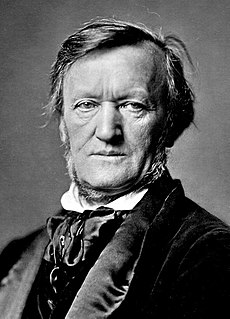
Music #400 - Wagner

Richard Wagner

/ˈvɑːɡnər/  (1813 – 1883)

Wagner changed the course of both opera and classical music in general. His aim was to create a "Gesamtkunstwerk", ≈ poetry + drama + music + song + painting.
        Wagner wrote both the music and libretto for every one of his works, and superintended staging and performance as his own director and conductor. 
        His compositions are notable for their complex texture, rich harmonies and orchestration. His understanding of the voice allowed him to write roles of huge length and complexity that were still singable, and which were able to penetrate the heaviest of orchestral textures.
In Bayreuth, he built a house and a theatre, the Festspielhaus, where he staged the Ring cycle and lastly, Parsifal.
        His influence on subsequent composers was uncalculable. He helped bring about the abandonment of the system of tonality. Poets and novelists referred directly to his inspiration.

Perhaps the two best-known extracts from his works are: 
- the Wedding March from the opera Lohengrin (below)
- The Ride of the Valkyries in Die Walküre (below)


Lohengrin 

is a Romantic opera, whose story is taken from medieval German romance. 
- with Spanish subtitles
     The story runs two days, in which Lohengrin was the knight who came in a boat (pulled by a swan) and departed in the same boat (pulled by a pigeon). 
     The most popular and recognizable part of this opera is the Bridal Chorus, better known as "Here Comes the Bride", often played in wedding processions.

Deeply moved by this fairy-tale opera, young King Ludwig II of Bavaria built his ideal fairy-tale castle, dubbed "Neuschwanstein" ("New Swan Stone"), after the Swan Knight.
(L) Neuschwanstein Castle (in Bavaria, Germany)
(R) Does it remind you of .....?


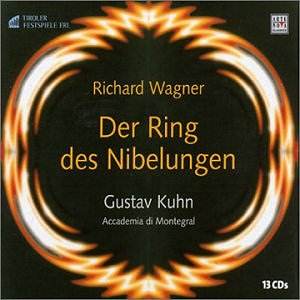
Der Ring des Nibelungen 

/ The Ring of the Nibelung
     The works are based loosely on characters from the Norse sagas and the Nibelungenlied.
     It is actually a complete opera festival in itself, a cycle of 4 epic operas:
* Ante-evening: Das Rheingold / The Rhine Gold (150m)
* Day 1: Die Walküre / The Valkyrie (225m)
* Day 2: Siegfried (255m)
* Day 3: Götterdämmerung / Twilight of the Gods (255m)

Selection from Day 1 - The Valkyrie
A valkyrie (chooser of the slain/女武神), in Norse mythology, is one of a host of female figures who decides who falls and dies in battle.  


* Adopted in the Apocalypse Now (1979 movie)
 

* Adopted in the Pearl Harbor (2001 movie)  


= = = = =

Großer Festmarsch 

/ Grand Festive March
- for the Opening of the Centennial Celebration of the Signing of the Declaration of Independence of the USA (1876)


= = = = =

The Flying Dutchman opera 

/ Der fliegende Holländer
(L) Overture
 
(R) Commentary 登上神壇


= = = = =

Tannhäuser und der Sängerkrieg auf Wartburg

- full title: Tannhäuser and the Singers' Contest at Wartburg Castle
Overture


= = = = =

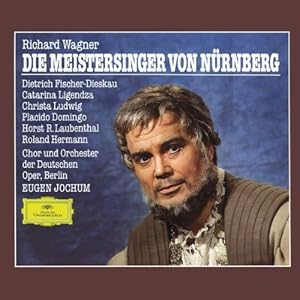
Die Meistersinger von Nürnberg 

/ The Mastersingers of Nuremberg

The story takes place in Nuremberg during the middle of the 16th century, when Nuremberg was an Imperial Free City, and one of the centers of the Renaissance in Northern Europe. It is his only opera centered on a historically well-defined time and place rather than a mythical or legendary setting.

    Three acts of 85 minutes each, totaling 4¼ hours.
 
(R) The Finale 


It revolves around the real-life guild of Meistersinger (Master Singers), who developed a craftsman-like approach to music-making. One of the main characters is based on an actual historical figure: Hans Sachs (1494–1576), the most famous of the historical Mastersingers. 


= = = = =

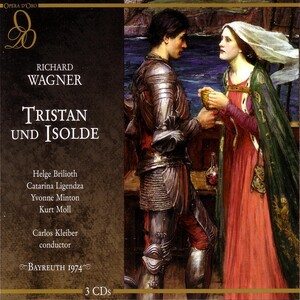
Tristan und Isolde

 
(R) deliberating lust with chromatic scale

Wagner referred to this opera (or music drama) not as an opera, but called it "eine Handlung" (literally a drama or a plot). It was notable for Wagner's advanced use of chromaticism, tonality, orchestral color and harmonic suspension. 
(L) Prelude
 
(R) Liebestod (death of love) @ end of Act 3

It was profoundly influential among Western classical composers and provided inspiration to composers. Many see Tristan as the beginning of the move away from conventional harmony and tonality, and consider that it lays the groundwork for the direction of classical music in the 20th century.


Source: Wikipedia


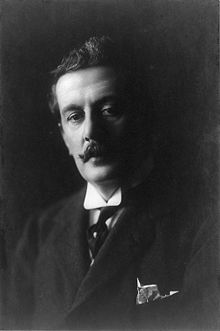
Music #399 - Puccini

Giacomo Puccini

[ˈdʒaːkomo putˈtʃiːni]  (1858 – 1924)

An Italian composer whose operas, including 
- La bohème, 
- Tosca, 
- Madama Butterfly, and 
- Turandot, 
are among the most frequently performed in the standard repertoire.

Puccini (plus Mascagni and Leoncavallo) added the new element of "verismo" realism to their operas, telling stories in music that were drawn from everyday life.

Some of his arias, such as 
- "O mio babbino caro" from Gianni Schicchi, 
- "Che gelida manina" / "What a cold little hand" from La bohème, and 
- "Nessun dorma" / "Nobody sleeps" from Turandot, 
have become part of popular culture.


Turandot

* Act 3 Scene 1 - "Nessun dorma"  (with lyrics)
 
(R)  Paul Potts at "Britain's Got Talent" show

* A 3-hour version of Turandot


La bohème

(L)  "Che gelida manina" / "What a cold little hand" 
 
(R)  Musetta's Waltz

(L)  “O soave fanciulla” / “Oh Sweet Girl”
 
(R)  Mimi's death


Madama Butterfly

Cio-Cio San (/cho-cho/ meaning butterfly-butterfly), a 15-year-old Japanese girl in Nagasaki, got married with a visiting US naval officer. As she converted to Christianity, she was abandoned by her relatives and friends. After some romantic time, he left.
She kept waiting for his return. Full of hope, she sings (in Italian!) about "One Beautiful Day" (Un bel dì), the opera's most famous aria and one of the most popular works in the soprano repertoire.
Three years later, the American husband finally returned, only that he was accompanied by his new American wife.
The abandoned 18-year-old butterfly blindfolded her son and slit her own throat, hoping that the American couple would take the mix-blood little son back to US. (Mix-blood was not acceptable then and there in Japan.) 


Tosca - "E lucevan le stelle" /
"And the stars were shining" aria


Music #398 - Verdi - Requiem, etc

Giuseppe Verdi

[dʒuˈzɛppe ˈverdi]  (1813 – 1901)

[Messa da] Requiem

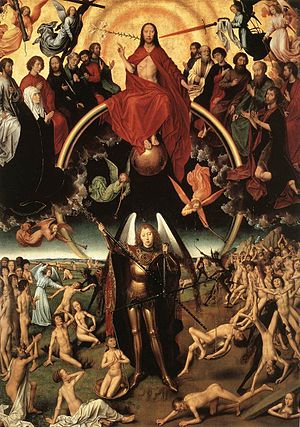
Last Judgment
- Section 2 of 7 
- Dies irae (Day of Wrath /
         
The 13th century Latin hymn describes the day of judgment, the last trumpet summoning souls before the throne of God, where the saved will be delivered and the unsaved cast into eternal flames.

The setting includes many highly operatic effects.
The fiery "Dies irae" is one of his most dramatic choruses:
 

A full mass:

Verdi wrote his Requiem in 1874 in memory of Manzoni, the great Italian novelist.
 
Last Judgment
- Pietro Cavallini (1259-c.1330, Italian) 
- fresco, c.1295
- Basilica of Santa Cecilia in Trastevere (Rome)
C: Christ on the throne, surrounded by Angels
L: Mary and six apostles on Christ's right
R: Saint John the Baptist and six apostles on Christ's left


La forza del destino 

/ The Force of Destiny


(Italian: [i ˈvɛspri sitʃiˈljaːni]; "The Sicilian Vespers") 
- a five-act Italian opera originally written in French for the Paris Opéra and translated into Italian shortly after its premiere

Elena gives thanks to all: Mercé, dilette amiche 
/ "Thank you, beloved friends"


Shakespeare's Plays

Verdi drew on Shakespeare's plays for three of his operas: Macbeth, Othello, and Falstaff.

Macbeth 

(L) Witches chorus
 
(R) Lady Macbeth's sleepwalking scene

A full opera (140 minutes)


Music #397 - Verdi - Aida

Giuseppe Verdi

[dʒuˈzɛppe ˈverdi]  (1813 – 1901)

Aida   

"Aïda is an Ethiopian slave to Amneris, daughter of  Pharoah Ramphis. She is in love with the Egyptian general Radamès, who is sent to lead the Egyptian army against Ethiopia.  When Radamès returns victorious, he is given Amneris as his bride. Amonasro, Aïda's father, is captured. He convinces Aïda to find out from Radamès the plan of his next campaign. Ramphis discovers this betrayal and Radamès is condemned to be walled up alive in a tomb, where Aïda joins him. They die together."

* A 2.7-hour version by San Francisco Opera


Selections: 

* Act 1 - Scene 1 - Celeste Aida

* Act 1 - Scene 2 - The grand gate of the city of Thebes
The Grand March
- the returning of the victorious army
 (with trophy and spoils, including strong or pretty slaves) to Egypt:


= = = = =

Bonus: 


* flashmob 

* The Grand March - with Danny Kaye conducting, facing the audience:


Source: Wiki