Friday, December 6, 2019

Sculpture #4 - Relief

Chapter 4 - Relief Sculpture


Last Judgment  (west tympanum/半月楣)
- Gislebertus in c.1120-35
- Cathedral of Saint Lazarus (Autun, Burgundy)


Isaac with Esau and Jacob (at the Gates of Paradise)
- Lorenzo Ghiberti
- gilded bronze (79 x 79 cm) 1425-52
- Florence Baptistery (Florence)


front cover of the Lorsch Gospels
- ivory panel (37 x 26 cm)
- Victoria and Albert Museum
The Lorsch (abbey in Germany) Gospels contains an illumination of Christ in Majesty.
The Lorsch Gospels
- Wolfgang Braunfels
- written in Latin, between 778 and 820.


Greek orotophorus (brazier)
- (53 cm, 30 cm dia.) End-12th Cent. (Byzantine)
- St. Mark's Basilica (Venice)


Pala d’Oro (Italian, "Golden Pall" or "Golden Cloth")
The high altar retable is universally recognized as one of the most refined and accomplished works of Byzantine enamel, with both front and rear sides decorated.
Pala d'Oro
(viewed in its altarpiece setting)
- Basilica di San Marco (Venice)

Pala d'Oro
(from a closer view)


The Adoration of the Magi
- John Flaxman (1755–1826, British)
- marble (23 x 43 cm) c.1792–94 (bas/low relief 淺浮雕)
- private collection
Magi [ˋmeidʒai] n. (聖經) 東方三博士
The Adoration of the Magi
- John Flaxman (1755–1826, British)
- graphite & watercolor on paper (28 x 46 cm) undated
- Yale Center for British Art (Yale)


The Madonna of the Stairs
- Michelangelo
- marble relief (57 x 40 cm) c.1491
- Casa Buonarrot (Florence)


The Ascension with Christ giving the Keys to St Peter
- Donatello (1386-1466)
- marble (41 x 114 cm) 1428-30 (schiacciato/淺平浮雕)
- Victoria and Albert Museum (London)


Tuerie
(Slaughter)
- Antoine-Augustin Préault (1809–1879, French)
- bronze (109 x 140 cm) 1834
- Musée des beaux-arts (Chartres)

Source: Wikipedia
Reference: Learning to Look at Sculpture (Mary Acton)


EXTRA:
high-relief plaque
The Death of Ophelia
- Sarah Bernhardt (1844-1923, French)
- white marble (70 x 59 cm) 1880
- private collection (Normandy) 


Trajan's Column
- marble (30+5 m H, 3.7 m dia) AD 107~113
- Trajan's Forum (Rome)
Trajan's Column is a Roman triumphal column that commemorates Roman emperor Trajan's victory in the Dacian Wars (AD 101–102, 105–106), although Trajan's statute atop was replaced by St. Paul's in the 16th century.

The shaft is made from a series of 20 colossal Carrara marble drums, each weighing about 32 tons. Inside the shaft, a spiral staircase of 185 steps provides access to a viewing platform at the top. The capital block of Trajan's Column weighs 53.3 tons.

The freestanding column is most famous for its spiral bas relief, which artistically represents the wars between the Romans and Dacians (101–102 and 105–106). The 190-metre frieze winds around the shaft 23 times. 


Soldiers and workers building fort walls:

Source: Wikipedia

Sunday, December 1, 2019

Sculpture #3 - Group Sculpture

Chapter 3 - Group Sculpture: interaction between forms


Equestrian statue: Charlemagne or Charles the Bald  
Charlemagne or Charles the Bald
- bronze, formerly gilded (25 cm) 9th century
- Louvre (Paris)
The monarch, holding an orb and a sword (now missing), asserts his authority as a conqueror.


Equestrian statue of Bartolomeo Colleoni (1400-1475)
Bartolomeo Colleoni
- Andrea del Verrocchio (1435–1488, Florentian)
- bronze (395 cm) c.1479-1488 (cast by Alessandro Leopardi)
- Campo Santi Giovanni e Paolo (Venice)


The Bronze Horseman
- an equestrian statue of Peter the Great
- the name comes from an 1833 poem of the same name by Pushkin
The Bronze Horseman
- Étienne Maurice Falconet (1716–1791, French) 1768–1782
- Senate Square (Saint Petersburg)
Catherine the Great (originally from Prussia) commissioned the construction of this statue, and had it inscribed with the phrase 'Peter the First / Catherine the Second / Summer 1782', in Russian.
One of her efforts to announce she (wife of Peter the Third whom she had overthrown via coup d'état) was the immediate successor to Peter the First.


Madonna and Child
Madonna and Child
- Giovanni Pisano (1248–1315, Italian)
- marble (97+35=132 cm) c.1302
- Museo dell'Opera del Duomo (Pisa)

Madonna and Child
- Henry Moore (1898–1986, English)
- bronze (155 x 85 x 70 mm) 1943
- Church of St Matthew (Northampton)

Rondanini Pietà
- Michelangelo (1475–1564, Italian)
- marble (195 cm) 1552-1564
- Castello Sforzesco (Milan)
Virgin Mary mourning over the emaciated body of the dead Christ.
The sculpture stood for centuries in the courtyard at the Palazzo Rondanini in Rome.


Samson Slaying a Philistine  
Samson Slaying a Philistine 
- Giovanni Bologna (1529-1608, Italian)
- marble (210 cm) c.1562
- Victoria and Albert Museum (London)


The Three Graces
The Three Graces
- Antonio Canova (1757-1822, Venetian)
- marble (180 cm) 1814-17
- Victoria and Albert Museum (London) &
Scottish National Gallery (Edinburgh), in turn
A Neoclassical sculpture of the mythological three charites, daughters of Zeus – from L to R, Euphrosyne (representing mirth), Aglaea (elegance) and Thalia (youth/beauty).
* There is another Canova's copy at the Hermitage Museum (St. Petersburg).

Cf. 
The Three Graces
- Jean-Baptiste REGNAULT (1754-1829, French)
- oil (204 x 153 cm) 1793-1794
- Louvre (Paris)


The Burghers of Calais
- Auguste Rodin (1840–1917, French)
- bronze (202 × 205 × 196 cm) 1884–89
- Town Hall (Calais)
Les Bourgeois de Calais commemorates an event during the Hundred Years' War, when Calais, a French port on the English Channel, was under siege by the English for about eleven months.
(See the big key to the city gate, to be surrendered to King Edward III of England, by this voluntary team of six?)
There are various copies by Rodin
at Washington DC, London .....


EXTRA:
Psyche Revived by Cupid’s Kiss
- Antonio Canova (1757–1822)
- marble (155 x 168 x 101 cm) 1777
- Louvre (Paris)

Venus Victrix
- Antonio Canova
- white marble, 1805–1808
- Galleria Borghese (Rome)
Pauline Bonaparte (1780–1825), as Venus Victrix, was a younger sister of Napoleon Bonaparte.


Source: Wikipedia
Reference: Learning to Look at Sculpture (Mary Acton)

Sculpture #2 - Free-standing Figures

Chapter 2 - The Free-standing Figure & Its Legacy


Royal Portals at Chartres Cathedral
 

West, or Royal Portal (12th century)
Central tympanum of the Royal portal.
Christ seated on a throne, surrounded by the symbols of the Evangelists;
a winged man for St. Matthew,
a lion for St. Mark;
a bull for St. Luke;
and an eagle for St. John.
Chartres Cathedral
- aka the Cathedral of Our Lady of Chartres
- French: Cathédrale Notre-Dame de Chartres
A Roman Catholic church in Chartres, France


David (in contrapposto / 旋動姿勢)
David
- Bernini (1598–1680, Italian)
- marble (170 cm) 1623-24
- Galleria Borghese (Rome)
Between 1618 and 1625 Bernini was commissioned to undertake various sculptural work for the villa of one of his patrons, Cardinal Scipione Borghese.

David
- Michelangelo (1475–1564, Italian)
- marble (517 × 199 cm) 1501–1504
- Galleria dell'Accademia (Florence)


David
Donatello (c.1386–1466, Italian)
- bronze (158 cm) 1440s
- Museo Nazionale del Bargello (Florence)

See also: 
Donatello (c.1386–1466, Italian)
- marble (210 x 88 x 54 cm) 1409-1415
- Museo dell'Opera del Duomo (Florence)


Penitent Magdalene  
A wooden (white poplar) sculpture of Mary Magdalene
Penitent Magdalene
- Donatello (c.1386–1466, Italian)
- wood (188 cm) 1453–1455
- Museo dell'Opera del Duomo (Florence)


Saint Francis Borgia  
Saint Francis Borgia (1510–1572, Spainish)
- carved by Juan Martínez Montañés (1568–1649, Spanish)
- painted by Francisco Pacheco (1564–1644, Spanish)
- wood (174 x 68 x 51 cm) c.1624
- Church of the Anunciación (Seville University)
This portrait is an imagen de vestir, a life-size mannequin dressed in real fabric (stiffened with glue); only the visible parts of the body, namely the head and hands, were carved. The work was commissioned by the Jesuits in Seville to mark Borgia's beatification in 1624. The figure would have originally held a real skull in its left hand.


Source: Wikipedia
Reference: Learning to Look at Sculpture (Mary Acton)

Sculpture #1 - Tradition & Types

Chapter 1 - Classical Tradition & Sculptural Types


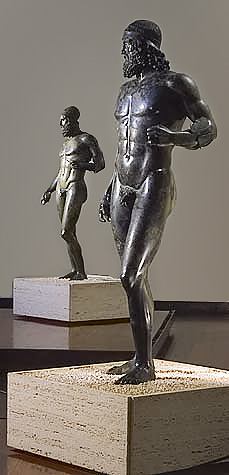
The Riace bronze 
- aka the Riace Warriors
- aka Bronzi di Riace [Italian /ˈbrondzi di riˈaːtʃe/]
Two full-size Greek bronzes of naked bearded warriors found in the sea near Riace in 1972.
The Riace Warriors
- Phidias in c.460–450 BC
- bronze (Statue A 198 cm, Statue B 197 cm)
- Museo Nazionale della Magna Grecia 
(Reggio Calabria, Italy)


The Winged Victory of Samothrace
- aka the Nike of Samothrace
A marble Hellenistic sculpture of Nike (the Greek goddess of victory)
The Winged Nike
- Parian marble (244 cm) c.200–190 BC
- Louvre (Paris)
Since 1884, it has been prominently displayed at the Louvre and is one of the most celebrated sculptures in the world. 羅浮宮三寶之一


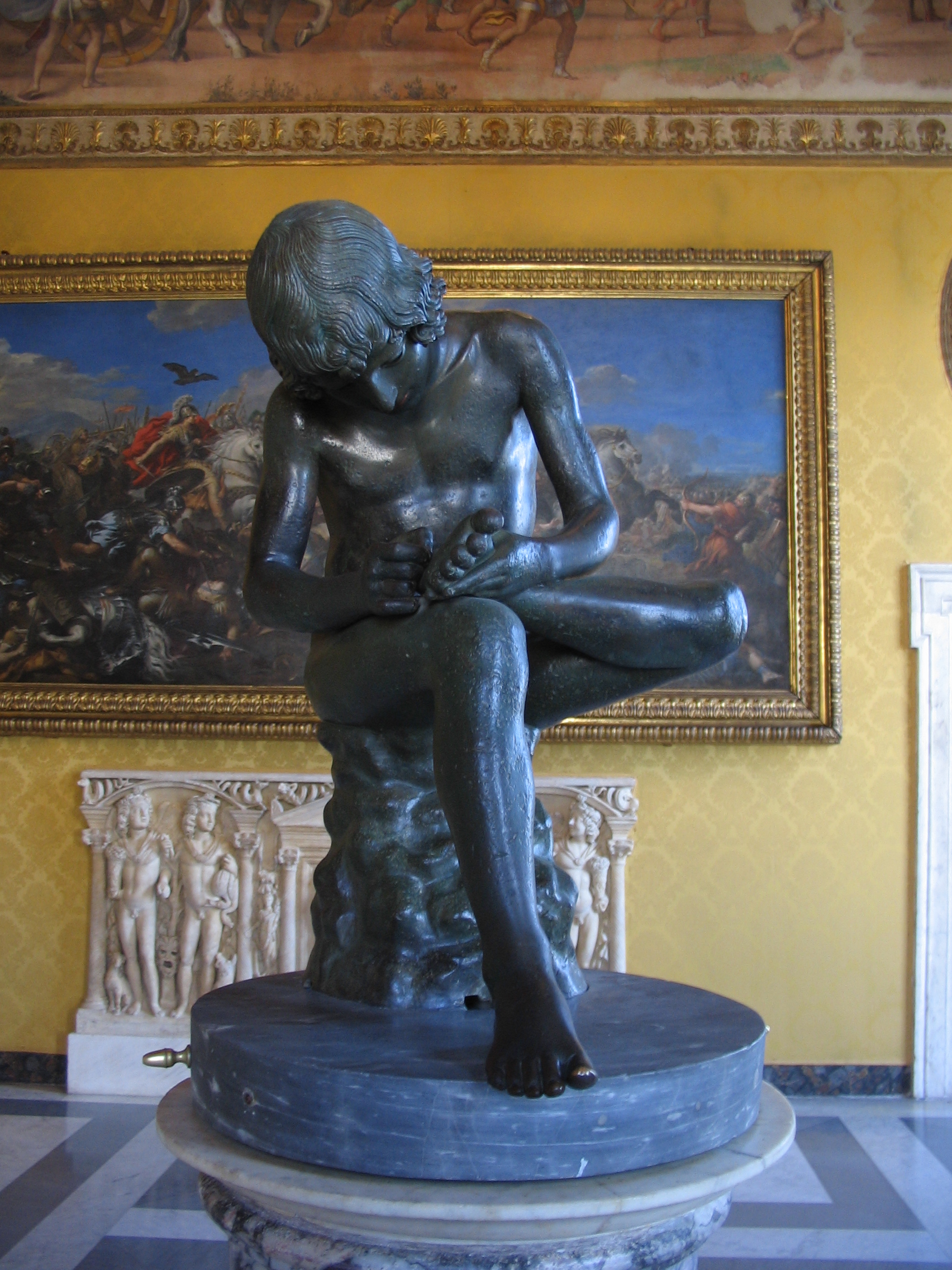
Boy with Thorn
- aka Fedele (Fedelino) or Spinario
A Greco-Roman Hellenistic bronze sculpture of a boy withdrawing a thorn from the sole of his foot.
Boy with Thorn
- bronze (73 cm)
- Musei Capitolini (Rome)
There is a Roman marble version of this subject from the Medici collections in a corridor of the Uffizi Gallery, Florence.


Farnese Cup
- aka Tazza Farnese
A carving bowl or cup in four-layered sardonyx agate.  Similar in form to a Greek phiale or Roman patera, with no foot. It features relief carvings on both its exterior and interior surfaces.
Farnese Cup
- made in Hellenistic Egypt
- cameo hardstone (20 cm dia.) 2°C BC
- National Archaeological Museum (Naples)


The Pergamon Altar
A monumental construction built on one of the terraces of the acropolis of the ancient Greek city of Pergamon in Asia Minor.
The Pergamon Altar
- first half of the 2°C BC
- (35.64 m wide, 33.4 m deep; the front stairway 20 m wide)
- Berlin Pergamon Museum
The base is decorated with a frieze in high relief showing the battle between the Giants and the Olympian gods.

West frieze (left side, at the north risalit)
 Left to right: Nereus, Doris, a Giant, and Oceanus
The ocean gods are gathered together on the north risalit of the altar. On the inside wall (stairway) are to be found the couple Nereus and Doris as well as Oceanus, and a fragment supposed to be Tethys, all of whom are engaged in fighting Giants.


The Parthenon Marbles
- aka Elgin Marbles
A collection of Classical Greek marble sculptures, which were originally part of the temple of the Parthenon and other buildings on the Acropolis of Athens.
 Parthenon Marbles
- Phidiasa in c.447–438 BC
- marble (75 m)
- British Museum (London)


Laocoön and His Sons
- aka the Laocoon Group
Copy after an Hellenistic original from c.200 BC.
Laocoön and His Sons
- marble (2.4 m) early 1°C BCE 
- Museo Pio-Clementino (Vatican City)


The Equestrian Statue of Marcus Aurelius  
Roman emperor from 161 to 180 and a Stoic philosopher.

Equestrian Statue of Marcus Aurelius

- bronze (4.24 m)
- Capitoline Museum (Rome)
'He is riding without the use of stirrups, which had not yet been introduced to the West.'

Equestrian Statue of Marcus Aurelius (replica)

- bronze (4.24 m) 1981
- Piazza del Campidoglio (Rome)


Portrait bust of Vespasian  
/vɛˈspeɪʒ(i)ən/
Roman emperor from 69 to 79.
Vespasian
- marble
Palazzo Massimo alle Terme (Rome) 


Marble bust of Hadrian
/ˈheɪdriən/
Roman emperor from 117 to 138
Hadrian (wearing military dress)
- marble
- National Archaeological Museum (Venice)

The location of Hadrian's Wall  in what is now northern England, 

and the later Antonine Wall in modern-day Scotland


Source: Wikipedia
Reference: Learning to Look at Sculpture (Mary Acton)