Wednesday, March 4, 2020

Painting #106 - Early Renaissance

Italian Renaissance :


The Early Renaissance  

(1400-1499) - Part 1/2


Florentine School

- an art movement of Italy in the 14-15th century, when Florence originated Italian Renaissance
- emphasized in shapes, scale, anatomy, sketches
 Il Duomo of Florence Cathedral
- Filippo Brunelleschi (1377-1466)
- (46-m-wide dome) 1436
- Basilica di Santa Maria del Fiore (Florence)


Masaccio 

(1401-1428, Florentian)

The Pisa Altarpiece 
- Masaccio
- tempera on gold ground and wood panel
- Church of Santa Maria (Carmine, Pisa) 

Detail of central panel:
Madonna and Child with Angels
- Masaccio
- tempera on wood (135 x 74 cm) 1426
- National Gallery (London)

(1383–1447, Italian)

The Annunciation
- Masolino
- tempera on panel (149 x 115 cm) 1423-24
- National Gallery of Art (Washington, D.C.) 


Domenico Veneziano 

(1410–1461, Italian)

Saint John in the Desert
(Saint John the Baptist in the Wilderness) 
- Domenico Veneziano
- tempera on wood (28 × 32 cm) c.1445
- National Gallery of Art (Washington, D.C.)


Giovanni di Paolo 

(1403–1482, Italian)

St John the Baptist Goes into the Wilderness
- Giovanni di Paolo
- tempera on poplar wood (31 x 39 cm) c.1454
- National Gallery (London) 


Putting things into perspective

The first known picture to make use of linear perspective:

- Fillipo Brunelleshi & Masaccio  

- fresco (255 x 598 cm) 1425  
- Cappella Brancacci (Florence) 
Depicted people: Jesus Christ, Peter


Illustrations in De pictura
- Leon Battista Alberti (1404–1472, Italian)
- book in Latin, comp. 1435, pub. 1450


Perspective Study of a Chalice
- Paolo Uccello (1397–1475, Italian)
- pen and ink on paper (29 x 24.5 cm) 15th century
- Gabinetto dei Disegni, Uffizi (Florence)  

(Perspective was applied to this painting of his:)
The Hunt in the Forest
- Paolo Uccello
- tempera, oil and gold on panel (75 × 178 cm) c.1460
- Ashmolean Museum (Oxford U)


Fra Angelico 

(c.1395–1455, Italian)

The Annunciation
- Fra Angelico
- tempera on panel (154 × 194 cm) c.1435
- Museo del Prado (Madrid)


 San Marco Altarpiece
(aka Madonna and Saints)
- Fra Angelico
- tempera on wood (220 × 227 cm) 1438–1443
- Museo di San Marco (Florence)
"In art, a sacra conversazione, meaning holy (or sacred) conversation, is a genre developed in Italian Renaissance painting, with a depiction of the Virgin and Child (the Virgin Mary with the infant Jesus) amidst a group of saints in a relatively informal grouping, as opposed to the more rigid and hierarchical compositions of earlier periods. 
     "Donor portraits may also be included, generally kneeling, often their patron saint is presenting them to the Virgin, and angels are frequently in attendance."


Deposition from the Cross
- Fra Angelico
- tempera on wood (176 × 185 cm) 1437-1440
- Museo di San Marco (Florence) 


Fra Filippo Lippi  

(c.1406–1469, Italian)

The Annunciation
- Filippo Lippi
- oil on panel (203 x 186 cm) c.1443-1450
- Alte Pinakothek (Munich)


 Barbadori Altarpiece
(aka Madonna and Child with St Fredianus and St Augustine)
- Fra Filippo Lippi
- oil on poplar panel (208 x 244 cm) 1437-38
- Louvre (Paris)


Madonna and Child 
- Fra Filippo Lippi
 - tempera on wood (95 x 62 cm) c.1465
- Uffizi Gallery (Florence)

Madonna with child and two Angels


Marsuppini Coronation
- Filippo Lippi after 1444
- tempera on panel (172 × 251 cm)
- Vatican Museums (Rome)


The Annunciation
- Filippo Lippi
- tempera on panel (68 x 152 cm) c.1448-50
- National Gallery (London)


 Seven Saints
- Filippo Lippi
- tempera on panel (68 × 152 cm) c.1448-50
- National Gallery (London
) 
A number of them were protectors or patrons of members of the Medici family on the rise to power.
[R1] Saint Peter of Verona, killed by an assassin, still has an axe on his head.


Perspective was applied to this painting:
Madonna with the Child
(and Scenes from the Life of St. Anne)
- [Fra'] Filippino Lippi
- oil and tempera on wood (135cm dia.) in 1452
- Museums of Florence
[Fra'] Filippino Lippi was an orphan raised by a friar, to be a friar. For this painting, he the painter (a monk) and the sitting model (a novice nun) fell in love, giving birth to a boy and a girl. The Pope pardoned them because of his painting talent, and allowed them to get married.

The boy, Filippino Lippi,  grew up to be another painter with the same name as his father:
Tobias and the Angel 
- Filippino Lippi (1457-1504, Italian)
- oil & tempera on panel (33 × 24 cm) 1475-80
- National Gallery of Art (Washington, D.C.)

= = = = =
EXTRA:

(Psalm 150 depicted in 8 panels on) Cantoria
 (singing gallery in Florence Cathedral)
- Luca della Robbia (1400-1482, Italian)
- marble sculpture with 8 relief panels, 1431-1438
- Museo dell'Opera del Duomo (Florence) 


The Marzocco
(the heraldic lion, a symbol of Florence)
- a replica of Donatello's
- Piazza della Signoria (Florence) 


Gates of Paradise
(east doors of baptistery) 
- Lorenzo Ghiberti (1381-1455, Italian)
- bronze relief (5 x 2 panels), c.1421
- Florence Baptistery  
L-R, T-B:
1. Adam & Eve     2. Cain & Abel
3. Noah     4. Abraham
5. Isaac with Esau & Jacob     6. Joseph
7. Moses     8. Joshua
9. David     10. Solomon & Queen of Sheba.

Reference: Wikipedia


Monday, March 2, 2020

Painting #105 - Late Gothic

Late Gothic Arts


Gerard David  

(circa 1450/1460–1523, Netherlandish)

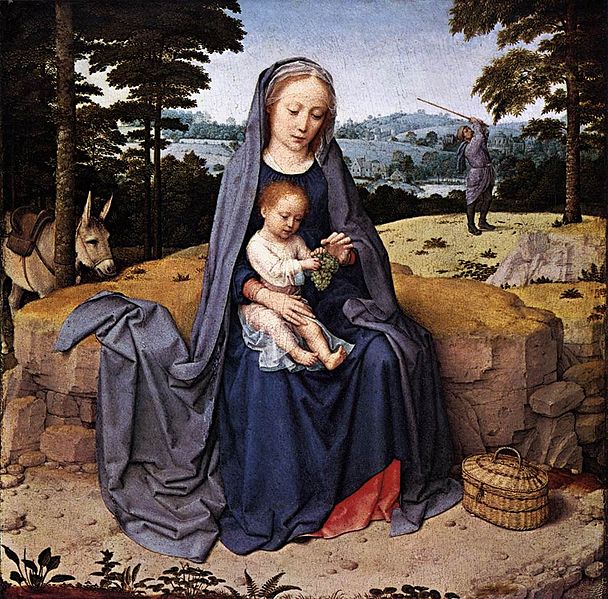
The Rest on the Flight into Egypt
- Gerard David
- oil on panel (42 x 42 cm) 1510
- National Gallery of Art (Washington, D.C.)


Hieronymus Bosch 

(c.1450–1516, Netherlandish)
He surnamed himself after the town of 's-Hertogenbosch, where he was born.

Triptych of the Temptation of Saint Anthony
- Hieronymus Bosch
  - oil on oak (132 × 53+119+53 cm) c.1505
-  Museu Nacional de Arte Antiga (Lisbon) 
Saint Anthony is kneeling in the middle of the middle panel, with demons and priestesses in the rest of the triptych.


The Path of Life (aka The Pedlar)
- Hieronymus Bosch
- oil on panel (135 x 90 cm) 1510-16
- Museo del Prado (Madrid)
When the two wings of The Haywain Triptych are flipped to shut it, their painted backs form a single scene depicting a wayfarer. Around him is a series of miniatures including the robbery of another wayfarer and a hanged man. The man uses a stick to repel a dog.

According to the most recent interpretations, this figure may represent the man who follows his road in spite of the temptation of sins (such as lust, perhaps symbolized by the two dancing shepherds) and the evil acts occurring around him.


Ship of Fools
- Hieronymus Bosch
- oil on oak panel (58 x 33 cm) 1494-1510
- Louvre (Paris)
The second fragment of the left wing of a triptych.


Death and the Miser
- Hieronymus Bosch
- oil on oak panel (93 x 31 cm) 1485-1490
- National Gallery of Art (Washington, D.C.)
Part of a triptych


Matthias Grünewald 

(c.1470-1528, German) 

Isenheim Altarpiece
- sculpted by Niclaus of Haguenau
- Matthias Grünewald
- oil on wood (300 x 328 cm center panel, 380 x 493 cm all out) in 1512-15
- Musée d'Unterlinden (Colmar, Alsace)
The triptych has 2 pairs of wings, displaying 3 configurations or views.


Reference: Wikipedia


Thursday, February 27, 2020

Painting #104 - Early Netherlandish

Early Netherlandish painting


In the 15th century, International Gothic styles furthered in 2 different directions:
* Florence in the South, leading to the Italian Renaissance;
* Netherlands in the North, leading to the Northern Renaissance.

The Early Netherlandish period begins approximately with Robert Campin and Jan van Eyck in the 1420s, and lasts at least until the death of Gerard David in 1523, although many scholars extend it to the start of the Dutch Revolt (1566 or 1568).

Early Netherlandish painters (aka the Flemish Primitives) are often categorised as belonging to both the Northern Renaissance and the Late or International Gothic.


Robert Campin  

(c.1375–1444, Netherlandish)

La Nativité
- Robert Campin
- oil on panel (85 x 71 cm) c.1425
- Musée des Beaux-Arts (de Dijon)

The Virgin and Child before a Firescreen
- Robert Campin
- oil and tempera on oak panel (63 x 49 cm) c.1440
- National Gallery (London)

Portrait of a Woman
- Robert Campin
- oil with tempera on oak (40 x 28 cm) c.1420s
- National Gallery (London)

Madonna and Child in a Garden with Saints in the Enclosed Garden
- Robert Campin
- oil on panel  (120 x 148 cm)  C.1440/1460
- National Gallery of Art  (Washington) 


The Shield of Parade 
(depicts knight in Italian armour of c.1470,
 kneeling before lady)
- British Museum (London)


Jan van Eyck  

(c.1390–1441, Netherlandish)

The Annunciation
- Jan van Eyck
- oil on canvas (90 x 34 cm) c.1434-1436
- National Gallery of Art (Washington, D.C.)


Enguerrand Quarton 

(1411–1466, French)
aka Master of the Pietà of Avignon

The Pietà of Villeneuve-lès-Avignon
- Enguerrand Quarton
 - tempera and gold on walnut wood (162 x 218 cm) 1457
- Louvre (Paris)
Jesus Christ, Mary Magdalena, John the Apostle


(c.1410/20-c.1475/76, Netherlandish)

The Man of Sorrows
- Petrus Christus
- oil on panel (12 x 9 cm) c.1445
- Birmingham Museum and Art Gallery (Birmingham) 


Rogier van der Weyden 

(1399/1400–1464, Netherlandish)

The Descent from the Cross
- Rogier van der Weyden
- oil on oak panel (220 x 262 cm) c.1435
- Museo Nacional del Prado (Madrid)
Depicted people: Jesus, Nicodemus, Joseph of Arimathea, Mary of Clopas, John the Evangelist, Salome, Mary Magdalena, Mary


Portrait of a Lady
- Rogier van der Weyden
- oil on panel (37 x 28 cm) c.1460
- Gallery of Art (Washington, D.C.) 


Hugo van der Goes 

(c.1440–1482, Flemish)

Portinari Altarpiece
- Hugo van der Goes
- color on wood triptych (254 × 140+305+140 cm) c.1467
- Galleria degli Uffizi (Florence)  


Dieric Bouts 

(circa 1420 –1475, Netherlandish)

Portrait of a Man 
- Dieric Bouts 
- oil with tempera on oak (32 x 20 cm) 1462
- National Gallery (London)


Hans Memling 

(c.1430–1494, Netherlandish)

Portrait of a Man with an Arrow
- Hans Memling
- oil on panel (31 x 25 cm) c.1470/5
- National Gallery of Art (Washington, D.C.)
St. Ursula Shrine
- Hans Memling
- carved and gilded wooden reliquary containing
oil on panel inserts (87 x 33 x 91 cm) c.1489
- Hans Memling Museum (Bruges, Belgium)
Saint Ursula led 11,000 virgins on pilgrimage from England to Rome, and on the return trip they were killed by pagans.


Guild of Saint Luke

The Guild of Saint Luke was the most common name for a city guild for painters and other artists in early modern Europe, especially in the Low Countries.

They were named in honor of the Evangelist Luke, the patron saint of artists, who was identified by John of Damascus as having painted the Virgin's portrait.

In most cities, including Antwerp, the local government had given the Guild the power to regulate defined types of trade within the city. Guild membership, as a master, was therefore required for an artist to take on apprentices or to sell paintings to the public.


Source: Wikipedia


Sunday, February 23, 2020

Painting #103 - International Gothic

International Gothic Styles

International Gothic is a period of Gothic art which began in Burgundy, France, and northern Italy in the late 14th and early 15th century. It then spread very widely across Western Europe.

Wilton Diptych
- unknown artist
- tempera on wood (each 46 x 29 cm) c.1395-1399
- National Gallery (London)
* so named because the diptych was previously hanged in Wilton House (Wiltshire, England)

LEFT panel:-
* Richard II (1367-1377-1399) of England kneels
* Edmund I (921-939-946) holds an arrow
* Edward the Conqueror (c.1004-1042-1066) holds a ring
* John the Baptist holds a little lamp (representing Christ)

RIGHT panel:-
* Child Christ, giving blessing, is hand-held by Holy Mother and surrounded by 11 angels each with a white stag breast-pin, which Richard II adopted as his heraldic emblem.


Adoration of the Magi
- Gentile da Fabriano (1370-1427, Italian)
- tempera on panel (300 × 282 cm) 1423
- Uffizi Gallery (Florence) 
TOP:
"The frame has three cusps with tondoes/圓形浮雕或畫 portraying: Christ Blessing (C); and the Annunciation from Archangel Gabriel (L) to Madonna (R).

MIDDLE:
"The panel portrays the path of the three Magi, in several scenes which start from the upper left corner (the voyage and the entrance into Bethlehem) and continue clockwise, to the larger meeting with the Virgin Mary and the newborn Jesus which occupies the lowest part of the picture.

BOTTOM:
"The predella has three rectangular paintings with scenes of Jesus' childhood:
(L) the Nativity

(C) the Flight into Egypt
and
(R) the Presentation at the Temple (its original now at the Louvre)."


Pisanello

(c.1380/1395 – c.1450/1455, Italian)

The Virgin and Child with Saints
- Pisanello (1395-1455, Italian)
- tempera on poplar (47 x 29 cm) 1435-41
- National Gallery (London)
Saint Anthony Abbot (L) rings his bell and glowers at Saint George (R), who is in armour and a stylish straw hat, with a slain dragon at his feet.

Saint George, England's Patron Saint,
in retrospective,
had a red cross as his coat of arms.
The red cross of Saint George represents 
England (and Wales) in the Union Jack.
Saint Anthony the Abbot (250/251-356/357, a Christian monk from Egypt) is the patron Saint of the pets, livestock, of the farmer and related and/or derivatives work (such as butchers, bakers, grocers, basket makers, shearers, etc.), of the gravediggers, fire, and skin diseases. In the past, many infectious diseases, particularly skin diseases, were referred to as St. Anthony's fire.
        Also considered the first of the abbots and founder and pioneer of the Christian monastic asceticism.


Portrait of a Princess
- Pisanello
- tempera on panel (43 × 30 cm) c.1435-45
- Louvre (Paris)


"The dead man before God"
in 《Grandes heures de Rohan》
- anonymous illuminator (nicknamed Rohan Master)
- tempera (27 x 19 cm) c.1418-1425
- Bibliothèque Nationale (Paris)  
The dead's last prayer is written in Latin on a white ribbon, "In your hands, oh Lord, I commend my spirit."

A demon attempts to steal his soul (in the form of a naked youngster), but is attacked by St Michael the Archangel, supported by an ionconspicuous army of angels.

God, with an orb in his left hand and a sword in his right, replies in French, "For your sins you will do penance and on the day of judgment you will be with me."

Black Death
took the lives of one-third European populace, peaking from 1347 to 1351.

Grandes Heures de Rohan
(The Grand Hours of Rohan; commonly known as The Rohan Hours) is an illuminated manuscript book of hours, in the Gothic style. It contains the usual offices, prayers and litanies in Latin, along with supplemental texts


The Meeting of St. Anthony and St. Paul
- Stefano di Giovanni (aka il Sassetta, 1392–1450, Italian)
   - tempera on wood (48 x 35 cm) c.1440
- National Gallery of Art (Washington, D.C.)
Saint Anthony, in his 90s and after a dream, abandons his hermitage and seeks Saint Paul, aged 113. After blessing and christening a centaur along his way, he meets Saint Paul. They both drop their walking sticks and caress each other.


Source: Wikipedia

Friday, February 21, 2020

Painting #102 - Early Gothic

Early Gothic

The Lorenzetti Brothers

* Pietro Lorenzetti (c.1280–1348, Italian) and
* Ambrogio Lorenzetti (c.1290–1348, Italian)
together introduced naturalism into Sienese art.

Both are believed to have died of bubonic plague in 1348.


Saint Sabinus before the Governor of Tuscany
- Pietro Lorenzetti (1280–1348, Italian)
- Tempera on poplar, altarpiece (37.5 x 33 cm) 1330s
- National Gallery (London)


The Charity of St. Nicholas of Bari
- Ambrogio Lorenzetti
- tempera and gold on poplar wood (30 x 20.5 cm) c.1330-c.1340
- Louvre (Paris)


The Allegory of Good and Bad Government
- Ambrogio Lorenzetti
- a series of 3 fresco panels (7.7 x 14.4 m (room)) 1338-1339
- Palazzo Pubblico (Siena)


In the Sala dei Nove ("Salon of Nine"), the paintings have been construed as being "designed to remind the Nine [magistrates] of just how much was at stake as they made their decisions".
Palazzo Pubblico (Siena)  
Source: Wikipedia


Painting #101 - Early Gothic

Early Gothic

Simone Martini 

(c. 1284 – 1344, Italian) was a major figure in the development of early Italian painting and greatly influenced the development of the International Gothic style.

Petrarch's Virgil (frontispiece/卷首插圖)
- Simone Martini
- parchment (30 x 20 cm) c.1336
- Biblioteca Ambrosiana (Milan) 
Petrarca was an Italian scholar and poet.
Virgil was an ancient Roman poet.


"Hail, full of grace, the Lord is with thee."
Annunciation with St. Margaret & St. Ansanus
- Simone Martini & (his brother-in-law) Lippo Memmi
- tempera and gold on wooden triptych panel
(265 x 305 cm) 1333
- Uffizi Gallery (Florence)


The Angel of the Annunciation
- Simone Martini
- tempera on poplar panel (30 x 21 cm) 1333
- National Gallery of Art (Washington, D.C.)


Christ Discovered in the Temple
- Smone Martini
- tempera and gold leaf on wood panel (50 x 35 cm) 1342
- Walker Art Gallery (Liverpool)
Father Saint Joseph discovered Christ in the temple and  brought him back to Holy Mother.

Source: Wikipedia